
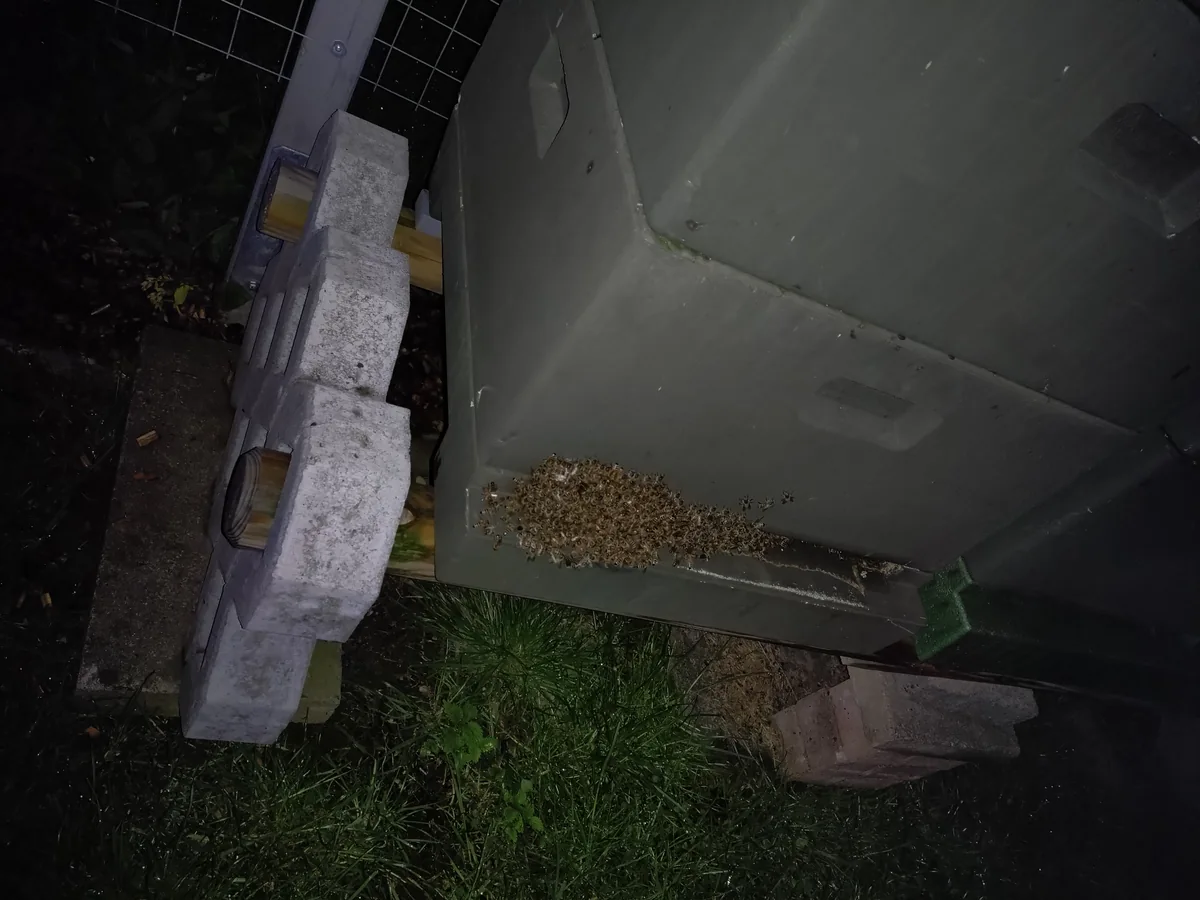
How does an animal sleep without closing its eyes?
A bee cannot close her eyes with eyelids. To recognise her sleep, we need other signs. Researchers observe posture, antennal movements and responses to stimuli. During sleep, honey bees remain relatively motionless for extended periods. Their antennae may droop and stay still for a long time in deeper stages of rest. The body becomes less tense, while the animals respond only to stronger stimuli.
What matters is the overall pattern. An animal pausing briefly is not necessarily asleep. Cold or illness can also reduce movement. In a study by Ada Eban-Rothschild and Guy Bloch, several behavioural stages of sleep were distinguished in young bees and foragers using such characteristics. Here sleep is a scientifically studied form of rest, not merely an assumption because a bee is doing nothing visible.
Night does not bring the colony to a halt
The image of a house where everyone switches off the lights at once in the evening does not fit a beehive. While foragers rest, other workers remain active. Young bees in the nest carry out tasks that cannot simply wait until morning. A sleeping bee therefore sits in the midst of a community whose activity continues.
Studies of marked workers show that sleep is distributed differently according to age and task. Foragers and bees storing food showed clearer daily rhythms, with longer periods of rest at night. In younger cell cleaners and nurses, this rhythm was less pronounced. They slept too, but their rest was distributed differently through the day. Saying “bees sleep at night” therefore describes part of what happens. It does not yet explain how an entire colony combines its work and its rest.
A cell can also be a resting place
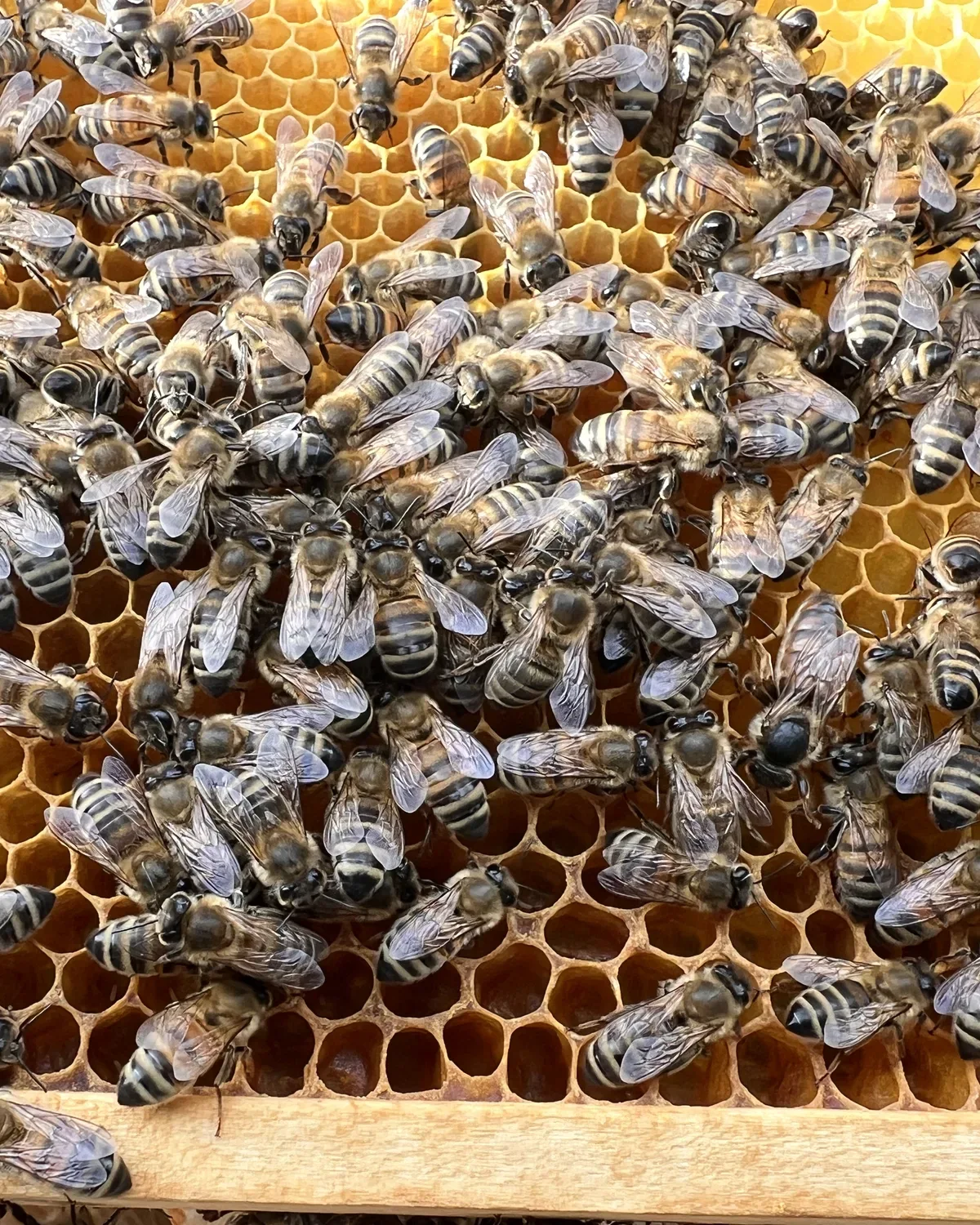
Where a bee sleeps is also associated with her stage of life. In a study using observation colonies, younger workers slept more frequently inside comb cells and closer to the brood area. Older animals tended to rest outside the cells and further towards the edge of the nest. The researchers mapped comb contents, bee locations and temperature to reveal this distribution.
A cell is therefore more than a container for honey or brood. At times, it can also shelter an adult bee at rest. Yet not every bee with her head in a cell is asleep: work happens there too. A photograph captures only a moment. Longer observation and further signs are needed for a more reliable interpretation. This distinction is small but important, especially when an image is meant to tell a big story.
What a still antenna can reveal
Sleep is more than a pause in movement. An important characteristic is that animals may sleep more afterwards if their rest has been interrupted. Such rebound sleep has been observed in honey bee experiments. This suggests that their rest is biologically regulated and cannot simply be missed at will.
To investigate relationships, researchers compare animals under defined conditions. They can examine, for instance, whether interrupted sleep changes behaviour the next day. Such experiments need suitable control groups: a difference might also arise from the disturbance itself. Studies in small observation colonies or individually housed bees each describe only a particular slice of life. It is precisely this care that makes the findings interesting. It transforms the touching image of a sleeping bee into verifiable knowledge about her life.
When a tired dancer gives less precise directions
A successful forager can indicate the direction and distance of a food source through the waggle dance. What happens to this message after a disturbed night? Barrett Klein and his research team investigated exactly that. Individual marked bees were repeatedly disturbed at night using small metal tags and moving magnets, while comparison animals were observed under other conditions.
The following day, the directional information in the dances of sleep-disturbed bees varied more widely. For distance information, however, the study found no corresponding deterioration. The result is therefore more precise than “tired bees can no longer dance”: in this experiment, sleep deprivation impaired the accuracy of one particular kind of information. The study published in 2010 shows how an individual worker’s rest can be connected with communication in the colony.
A night between experience and memory
Sleep is also associated with retaining new experiences. A team led by Lisa Beyaert, Uwe Greggers and Randolf Menzel released foragers at an unfamiliar location. On the flight home, the bees could acquire new information about the surroundings. The researchers then tested how well they later found their way back from the same place.
When their rest was disturbed on the night after this learning experience, fewer animals returned successfully in the subsequent trial. Sleep deprivation before the first task did not have the same effect. The finding suggests that night-time sleep supports the consolidation of newly acquired navigational information. It does not mean that bees consciously fly over a landscape again in their sleep. Precisely what happens in the brain remains a research question. What is initially certain is the measured relationship between the night after learning and later homing success.
Research recognises its limits too
Not every form of learning responds in the same way to sleep deprivation in experiments. In a study of odour learning, retention of a newly learnt association between an odour and a sugar reward remained unaffected. What changed, however, was retention of the later experience that the familiar odour no longer predicted a reward. This adjustment is known as extinction learning.
This makes the story more precise and more interesting. Sleep is no magical switch that improves every bee ability equally. Different tasks and experimental conditions yield different results. Nor can these findings tell us whether bees dream. We can measure signs of sleep and examine consequences. That does not establish an inner world of images. Closeness to an animal can also grow from respecting the boundary between what we have seen and what we have imagined.
The most beautiful observation needs no disturbance
When visiting a supervised observation hive, you can look for rest alongside dancing and brood care. Does a worker stay in the same place for a long time? How do her antennae behave? Does movement continue around her? Ask an expert to show you what they look for, and watch the animal for a little longer. A single sign rarely supports a confident conclusion.
Do not open a hive at night for such observations, or wake animals with light or touch. Simply knowing about their rest changes the way we look the next day. Among all the foraging flights, stores and dances, there is a part of life that scarcely stands out in photographs. The bee sitting still is not absent from the colony. Her rest too belongs to the community that keeps on humming.
Sources & further reading
- Eban-Rothschild & Bloch (2008): Differences in the sleep architecture of forager and young honeybees
- Klein et al. (2008): Caste-dependent sleep of worker honey bees (Volltext, PDF)
- Klein et al. (2014): Mapping Sleeping Bees within Their Nest
- Klein et al. (2010): Sleep deprivation impairs precision of waggle dance signaling in honey bees
- Beyaert, Greggers & Menzel (2012): Honeybees consolidate navigation memory during sleep (Volltext, PDF)
- Hussaini et al. (2009): Sleep deprivation affects extinction but not acquisition memory in honeybees