
.jpg)
A brown dot with a large impact
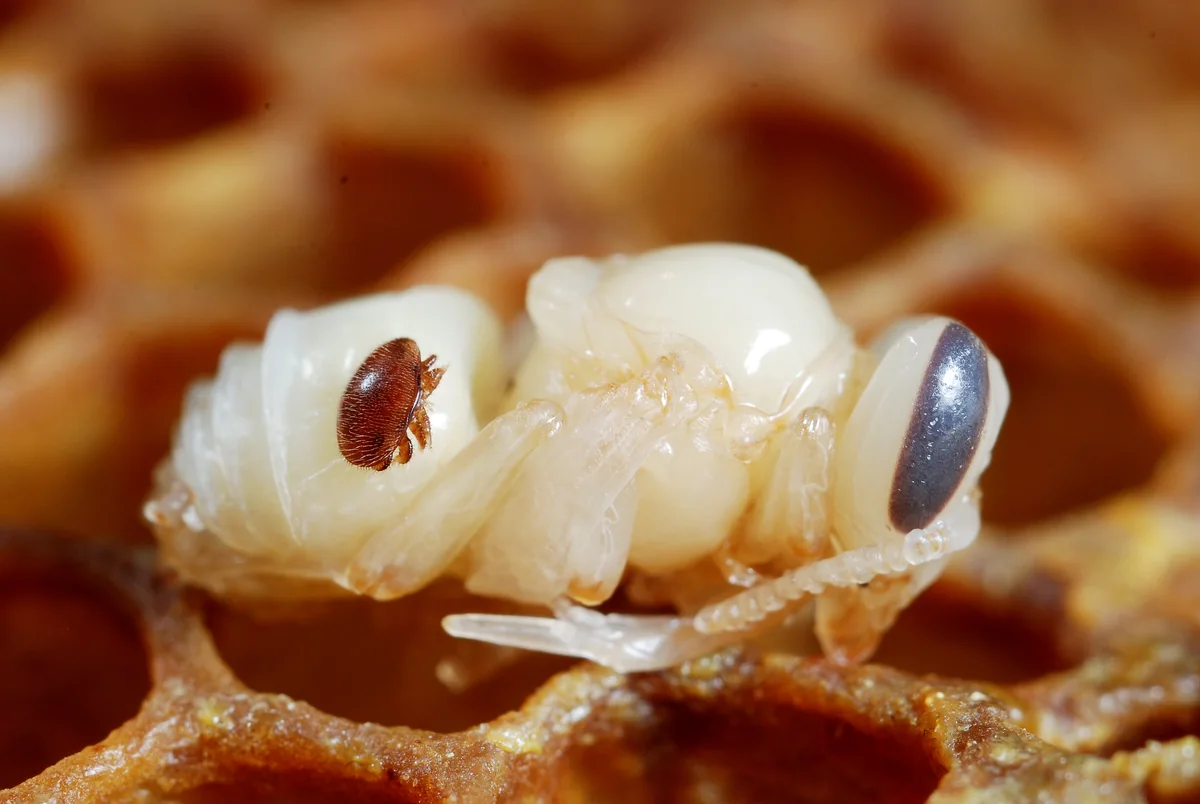
The adult female Varroa mite is flat, oval and reddish-brown. It is about one and a half millimetres wide, wider than it is long. Under a magnifying glass, the apparently insignificant dot becomes an animal with eight legs. Varroa is an arachnid, not an insect. The bee it sits on, by contrast, has six legs.
The flat shape helps the parasite fit tightly against a bee’s body. Photographs sometimes show mites clearly on the back. In a colony, however, they may also be hidden between the abdominal segments. A superficial look therefore captures only part of what is happening. The scientific name Varroa destructor identifies this particular parasite of our honey bees. Not every small mite on an insect belongs to this species.
An encounter with consequences
Varroa originates from an association with the eastern honey bee, Apis cerana. This original host has defence mechanisms that limit the parasite’s reproduction. The keeping and exchange of colonies brought the mite into contact with the western honey bee, Apis mellifera, too. On this host, it can reproduce in both worker and drone brood and cause serious harm.
This is therefore a changed relationship between two species. A parasite kept in check on its original host encounters another host with different characteristics. In central European beekeeping, monitoring and managing Varroa infestation is consequently part of routine care. The existence of resistant colonies does not make this work unnecessary. It opens research questions: which traits help them, and how can those traits be reliably retained?
The nursery becomes a hiding place
To reproduce, a female mite moves from an adult bee into a brood cell shortly before workers seal it with a wax cap. Beneath that cap, the bee continues developing. At the same time, the mite begins reproducing. Its first egg usually becomes a male, followed by females. The offspring develop and mate inside the cell.
When the adult bee emerges, the mother mite and mated daughters that have matured in time can leave the cell. Not every reproductive attempt succeeds completely. The process is closely tied to the host’s development. Drone brood remains capped longer than worker brood, allowing more time for mites to develop. It therefore has a particular role. What looks from outside like a quietly sealed cell can house two life cycles at once.
More than a little blood loss
For a long time, Varroa was described chiefly as a bloodsucker. Bees do not have blood like ours but haemolymph, their body fluid. Yet that comparison alone does not explain the damage. A 2019 study by Ramsey and colleagues showed that mites on adult bees mainly consume fat body tissue. The fat body is involved in metabolism, storage and defence; it is far more than a fat pad.
More recent research has refined the picture further: in 2024, Han and colleagues found that mites on bee pupae predominantly consumed haemolymph. Diet apparently also depends on the host’s developmental stage. The blanket statements “Varroa only sucks blood” and “Varroa always eats only fat body” therefore both fall short. What is certain is that the mite injures and exploits living bees and their brood. It is not merely a harmless passenger.
One parasite opens further routes
Virus transmission adds to the direct damage. Deformed wing virus, or DWV, is particularly important. Varroa mites can transmit it while feeding. In severe infections, bees may emerge with deformed wings; their lifespan can also be seriously affected. An animal that can never fly properly will later be missing as a forager. Many damaged individuals eventually affect the performance of the entire colony.
Virus and mite nevertheless remain different organisms. The mite is not itself a virus, nor does every unusual wing establish the same cause. Bees that look normal can also be infected. Visible symptoms are clues, not a complete diagnosis. Managing the parasite is an important way of limiting this transmission route. Understanding depends on their interaction: a tiny feeding site can have consequences extending far beyond that individual wound.
Winter begins long before the frost
In summer, a colony may still look strong while mite numbers increase in its brood. Later, bee numbers decline. At the same time, the bees that will carry the colony through the cold season must develop. A comparable mite population is then spread over fewer bees. Low infestation is especially important during the rearing of winter bees.
Under favourable conditions, winter bees live much longer than summer workers. Their role extends beyond the next flower: they maintain the community and allow it to restart in spring. If they are seriously damaged during development, abundant food stores alone cannot compensate. A colony may have enough food yet too few healthy, long-lived bees. Attention to bee health must therefore begin before the first cold day.
A full hive is not yet a diagnosis
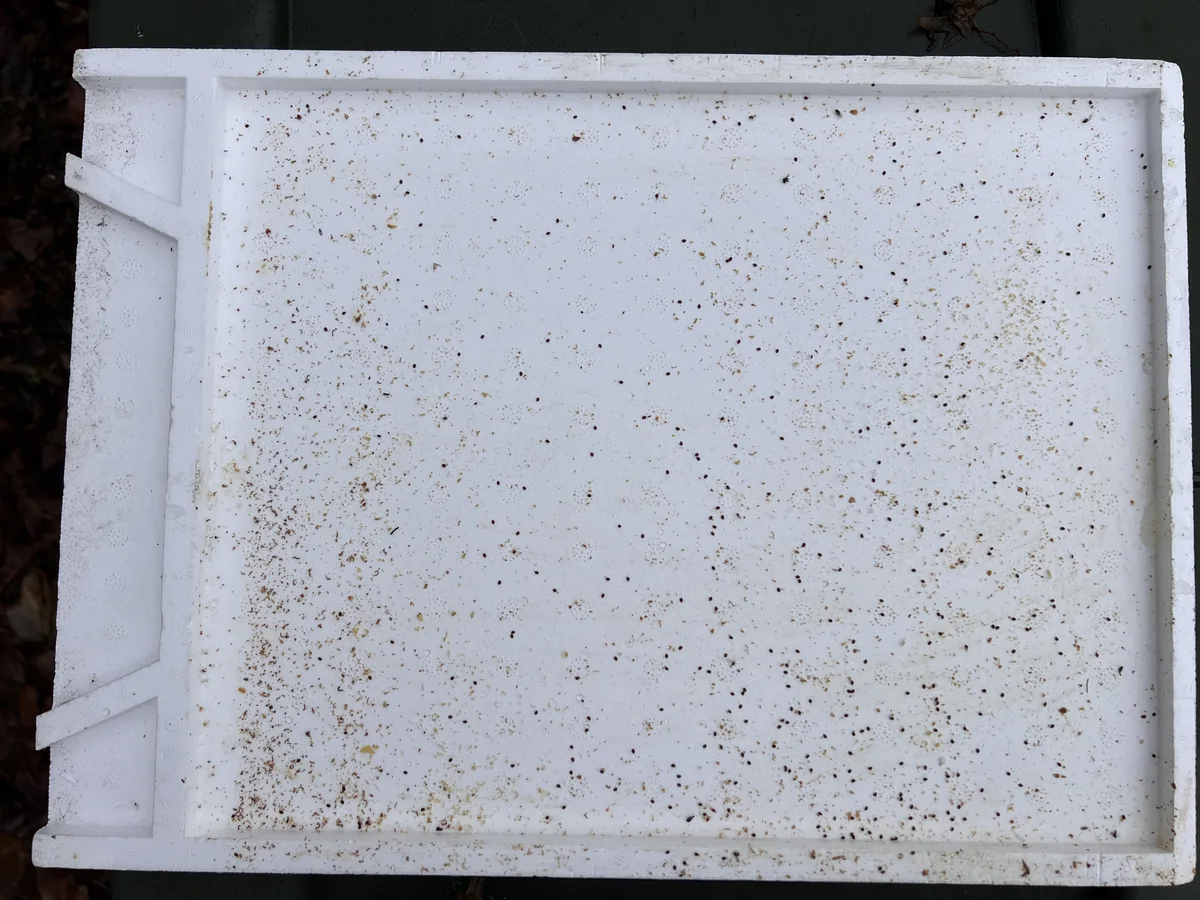
Busy flight activity is a pleasure to watch. It does not, however, reliably reveal the level of Varroa infestation. Beekeepers therefore use suitable monitoring methods. Monitoring mite drop, for example, examines how many mites fall onto a protected board beneath the colony within a defined period. The brown bodies are sought and counted among wax crumbs and other debris.
A single dot in a photograph is not enough. A defined observation period is needed, and season, brood activity and previous interventions must be considered. Testing bee samples answers a different question again from measuring natural mite drop. Results cannot be converted into one another arbitrarily. In practice, appropriate guidance, careful execution and repeated checks belong together. Observation becomes reliable only when we know what we are measuring — and the limits of the result.
Health needs context
Managing Varroa is a task throughout the beekeeping year. It may include measures that interrupt the brood cycle and authorised veterinary medicines used in a way suited to the colony’s situation. Methods such as “Teilen und Behandeln” (“split and treat”) combine interventions in colony development with targeted treatment of broodless units. What matters is the combination of a sound assessment, appropriate timing and checking the effect.
Mites may be brought in again even after a successful intervention, for example by drifting bees or through robbing between colonies. One good result therefore promises nothing for the rest of the year. This article explains the relationships; specific treatment steps belong within a current, regionally appropriate management plan. For a beekeeper’s own colonies, a bee research institute and professional advice provide the appropriate next step. Dosages and conditions of use depend on the authorised product concerned.
What care means here
Anyone who does not keep bees need not count mites. During a guided visit, however, a new question is worth asking: how do you tell how the colony is doing? A comb, a monitoring board and records of the year reveal how much work lies behind a hum that seems so effortless.
Research investigates traits that help bees limit the parasite more effectively. These include hygienic behaviour towards infested brood. Such approaches need verified results and do not automatically replace monitoring a particular colony. Meanwhile, care remains precise, recurring work: observing, interpreting, acting and looking again. A jar of honey shows a season’s result. The attention that helped keep the colony healthy through that season usually remains invisible.
Sources & further reading
- University of Florida IFAS: Varroa destructor – Erkennung und BiologieBody shape, size and developmental stages.
- Agroscope: VarroaHost shift, reproduction and research approaches. Some older dietary and distribution information is put in context using more recent studies.
- Purdue Extension: Biology and Control of Varroa MitesReproduction in brood cells; the article distinguishes dietary stages using more recent research.
- Ramsey et al. (2019): Varroa destructor feeds primarily on honey bee fat body tissue and not hemolymphPrimary study on consumption of fat body tissue.
- Han et al. (2024): Life-history stage determines the diet of ectoparasitic mites on their honey bee hostsPrimary study on differences in feeding on adult bees and pupae.
- Agroscope: VirenThe relationship between Varroa, virus transmission and bee health.
- LAVES, Bieneninstitut Celle: Varroose – eine Brutkrankheit der HonigbienePrinciples of the annual cycle and rearing healthy winter bees; no old treatment instructions adopted.
- LAVES: Leitfaden zur Varroa-Bekämpfung – Grundlagen der GemülldiagnosePrinciples of infestation monitoring. A historical guide; no current dosages taken from it.
- LAVES: Varroa-Bekämpfungskonzept Teilen und BehandelnThe relationship between brood interruption and treatment.
- University of Minnesota Bee Lab: Varroa MitesChecks before and after interventions, reinfestation and research on resistant bees.