
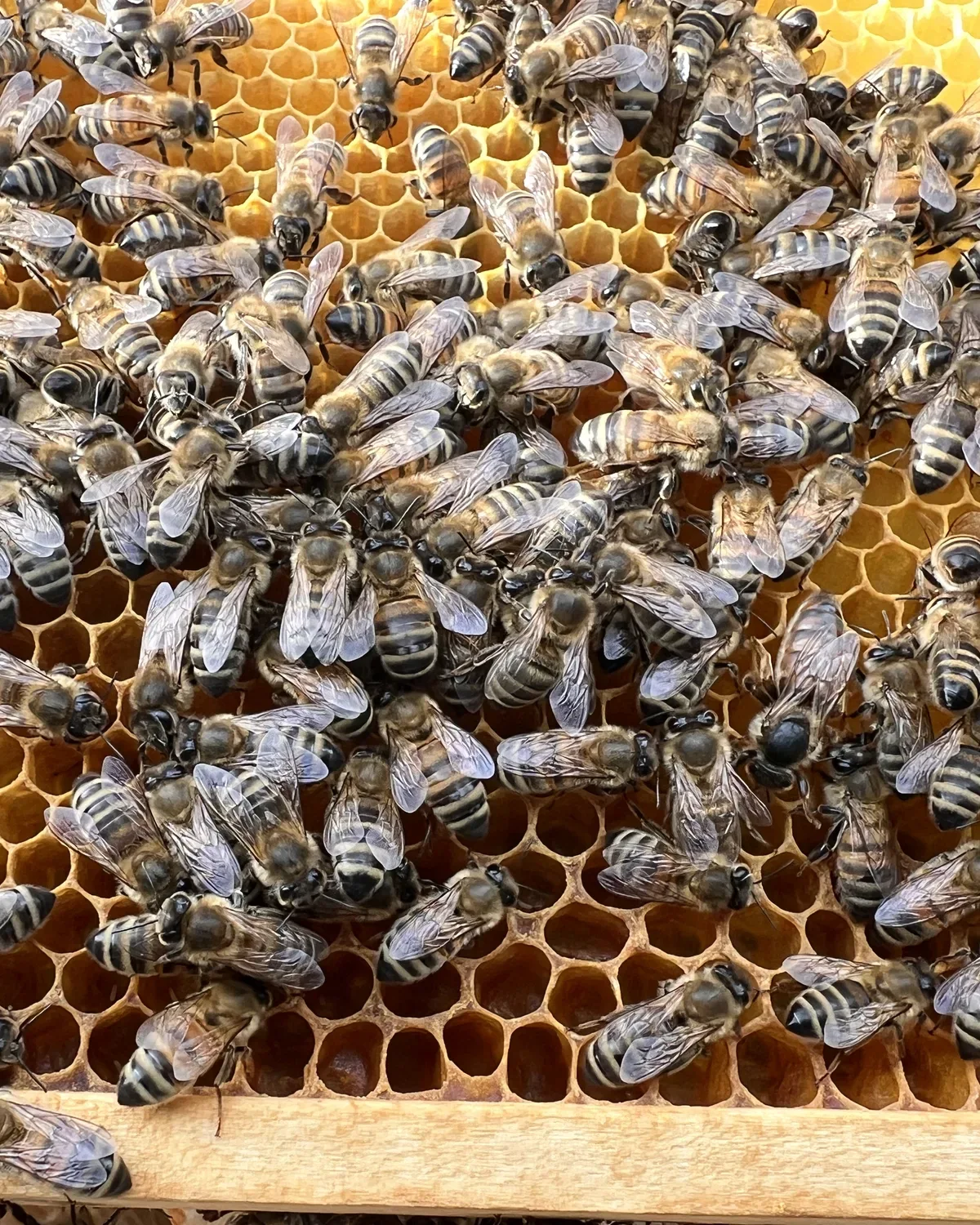
Three bodies, three ways of life
The honey bee kept here is Apis mellifera. Its colony consists mainly of female workers, usually one queen and, during the reproductive season, male drones. Workers care for brood, build comb, process food, guard the nest and forage outside. The queen lays eggs. Drones can mate with young queens, passing on the genes of their colony of origin.
Workers and queens normally develop from fertilised eggs. An unfertilised egg develops into a drone. Which female larva becomes a queen depends substantially on its provisioning during the larval stage. There is no special “queen egg” type. Queen larvae receive abundant special brood food and grow in queen cells.
From egg to adult bee
All three kinds of bee pass through egg, larval and pupal stages. Under normal conditions, a queen emerges about 16 days after the egg is laid, a worker after 21 and a drone after 24 days. These are typical developmental times, not deadlines accurate to the minute. Temperature and the colony’s condition can affect the process.
Emergence is only the beginning of adult life. A young worker has not already spent three weeks as a forager. She begins inside the hive; drones also need further time after emergence before they can mate.
A life without a fixed timetable
Young workers keep cells clean and later tend larvae and the queen. Other tasks include maintaining stores, building comb and working at the entrance. Many switch to regular foraging after around two to three weeks. This sequence is a guide. Tasks overlap, and not every bee performs every activity.
If foragers are missing, younger bees can fly out earlier. If the colony needs more brood care, older bees can resume tasks inside the hive. Research on division of labour shows this flexibility. The colony has no fixed duty roster: age, physical condition, food and the community’s needs work together.
Wax becomes a shared home
Workers produce wax in glands on the underside of their abdomen. Small wax scales are worked with the mouthparts and shaped into cells. Production requires energy from the colony’s food. Here too, the task depends on the bees’ condition and the community’s needs.
A comb is simultaneously a nursery, store and workspace. Brood develops in its cells; others contain pollen or honey. Drone cells are larger than worker cells, while queen cells have a different shape. Comb structure connects many tasks within a small space. It is neither merely a honey store nor a building prescribed by the queen.
How a larva becomes a queen
Queens and workers usually begin life with the same possibilities. During the larval stage, differences in the quantity, composition and course of feeding produce different bodies. All young larvae receive brood food; queen larvae receive particularly abundant food and are fed differently throughout their development. One single “queen-making substance” does not adequately explain this transformation.
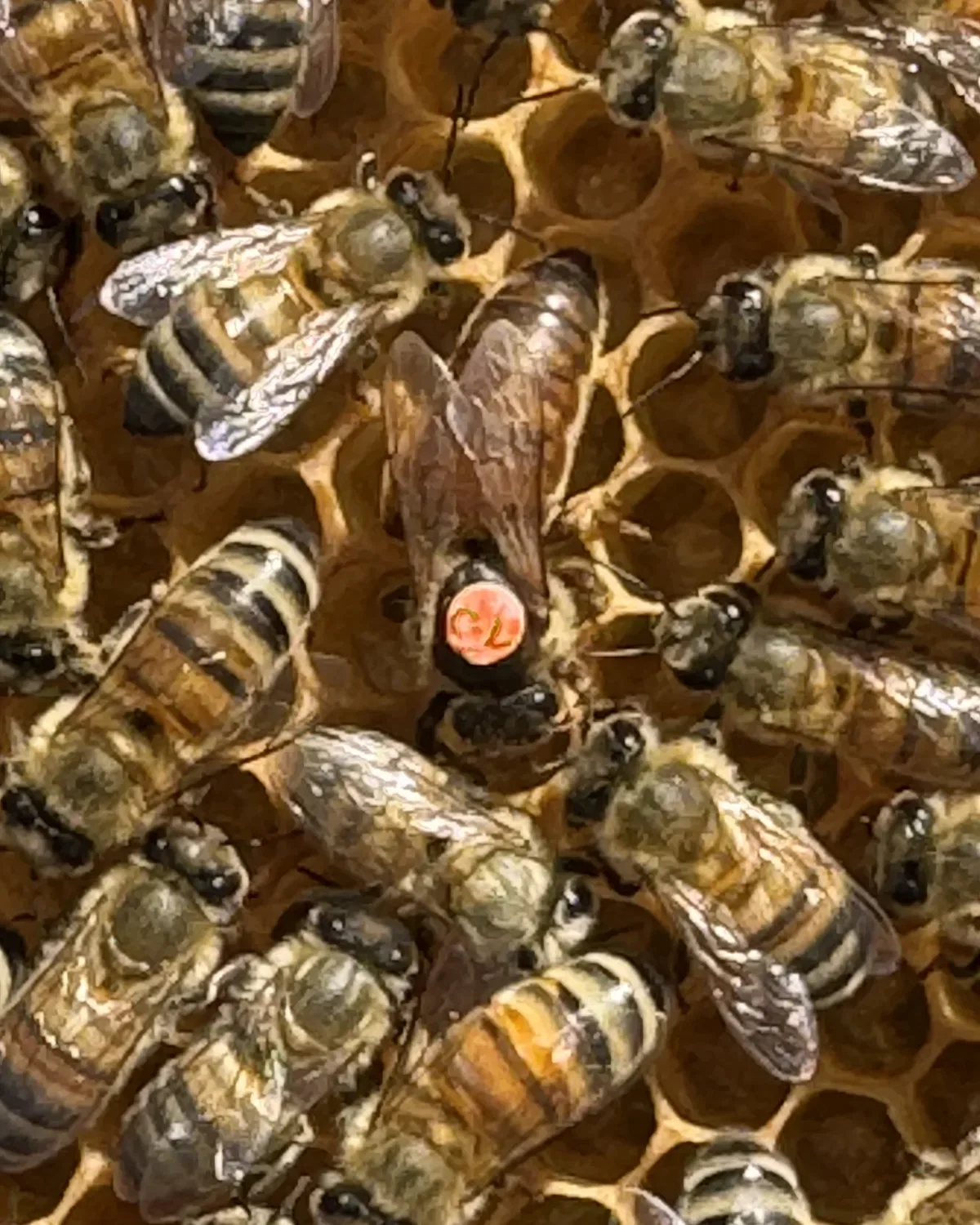
A queen cell provides room for this rearing. If a queen is lost, workers can also select a suitable young larva from a worker cell and enlarge its cell. An emerged queen has more developed ovaries and a long abdomen. She depends on provisioning by workers. Her distinctive appearance does not make her the colony’s commander.
Mating and years of storage
A young queen makes orientation and mating flights when conditions are suitable. She usually mates with several drones from different colonies. Successful mating is fatal for the drone: his mating organ is irreversibly everted, he falls away and dies shortly afterwards. Many drones never reach a queen.
The queen stores sperm in her spermatheca. Some remains usable for years. Only later, during egg laying, is it used to fertilise eggs. Her laying rate changes with season and supplies. “Fertilised means female” is a useful basic rule with genetic exceptions: under particular combinations at the sex-determination gene, males can also develop from fertilised eggs.
Drones: genes on the wing
An ordinary drone develops from an unfertilised egg. He has only one set of chromosomes and no genetic father. Nevertheless, he is not a clone of the queen: maternal genetic material is recombined during egg formation. Drones have large eyes, powerful flight muscles and no sting.
After emergence, they need around one to two weeks to reach sexual maturity. They can then fly out repeatedly and visit several aerial congregation areas, where drones from different colonies gather. Young drones are fed extensively by workers; older ones can also take honey directly from comb cells. They generally collect no food for the colony. As food availability declines and the reproductive season ends, many are driven out of the hive. There is no fixed autumn date.
How the colony stays connected
Bees exchange information through touch, smells and movement. A successful forager can use the waggle dance to indicate the direction and distance of a rich food source. Scents additionally help other foragers locate the flower they are seeking. The dance is not an order, but information other bees can use.
The queen’s chemical signals also contribute to life together. Nevertheless, she does not direct every activity. She depends on workers for feeding and care. The name “queen” therefore describes her reproductive role only imperfectly.
When a colony reproduces
Swarming is natural reproduction at colony level. Growth and space play a role; queen age, genetic predisposition and the ratio of brood to nurse bees also influence the process. In the prime swarm, the old queen leaves the nest with some of the workers. Young queens are being reared in the original colony.
The swarm often first gathers as a cluster. Scouts explore possible nesting sites and exchange information through dances and other signals. The choice emerges from their interaction. The queen does not search for the new home alone. Afterswarms with young queens are possible; division is no guarantee of success for both resulting colonies.
The colony changes with the seasons
In spring, the brood nest grows; in summer, foraging and building stores can be particularly intensive.
Later, brood activity usually declines. Longer-lived winter bees carry the colony through the cold season and tend the next generation in spring. In cold weather, the bees sit in a winter cluster and generate heat with their flight muscles. They do not hibernate. An individual summer life often lasts only a few weeks; the community can endure through generations.
Sources & further reading
- LWG: Biologie der Bienen
- Rueppell et al.: Aging and demographic plasticity in honeybees
- Universität Würzburg: Forschung zum Schwänzeltanz
- LWG: Bienenpflege im Jahresverlauf
- Washington State University: Honey Bees and Other Pollinators
- Johnson (2010): Division of labor in honeybees
- Slater, Yocum & Bowsher (2020): Diet quantity influences caste determination in honeybees
- Brutscher et al. (2019): Putative Drone Copulation Factors Regulating Honey Bee Queen Reproduction and Health
- Penn State University: Honey Bee Genetics Basics
- Woodgate et al. (2021): Harmonic radar tracking reveals that honeybee drones navigate between multiple aerial leks
- Richardson et al. (2024): Pheromone relay networks in the honeybee
- Seeley et al. (2012): Stop signals provide cross inhibition in collective decision-making by honeybee swarms