
.jpg)
Many facets, a different view
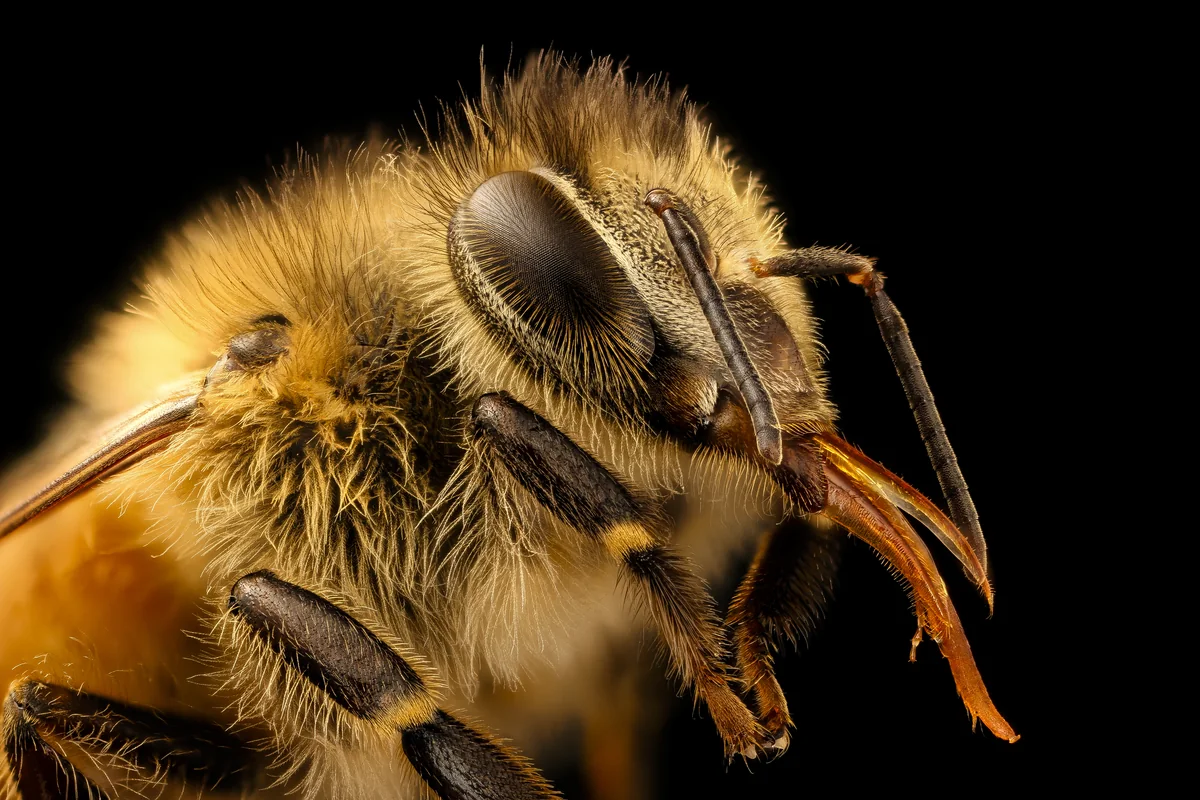
The two large eyes on either side of a honey bee’s head consist of many small visual units called ommatidia. Each has its own lens and receives light from a limited area. Their signals are processed in the nervous system. The eye therefore does not give the bee thousands of complete copies of the same flower, as some illustrations suggest. The many units contribute jointly to perception of the surroundings.
Three small simple eyes, the ocelli, also sit on top of the head. They complement the large compound eyes. These dark dots can be seen in a good macro photograph. Even the anatomy is unfamiliar to us: a face that seems familiar carries a very different optical system. A bee must use this system to land, avoid obstacles and find food. Her vision is therefore better understood through these tasks than by asking whether her image resembles ours.
Ultraviolet, blue and green
Honey bees have three types of colour receptor, with peak sensitivities in the ultraviolet, blue and green regions. Humans with ordinary colour vision also use three receptor types, but with different spectral sensitivities. Some of the light reflected by a flower therefore reaches a distinct colour channel in a bee while remaining invisible to our eyes. For her, the landscape has different colours.
This does not allow a simple translation such as “yellow becomes blue”. Colour arises from the interplay of receptors, lighting and processing in the nervous system. It is equally misleading to say that red flowers are invisible to bees. They have no dedicated red receptor like ours, but may still recognise and visit such flowers depending on reflection, contrast and other signals. Our colour names describe our view of a flower. They are no guide to how a bee experiences it.
A flower can show more than we see
Some petals have areas that reflect or absorb ultraviolet light to different degrees. Under suitable UV photography, dark centres, rings or other patterns can appear, although the flower looks largely uniform in colour to us. Such contrasts are among the potential sources of information for a bee approaching and exploring a flower. Lines, dots and colour changes visible to us can also play a part.
These markings are often called nectar guides or floral guides. They can lead visitors towards food or particular points of contact. Yet flowers do not all bear the same target: species differ, and a pattern’s effect depends on its context. Size, distance and background change what can be recognised. Ultraviolet is one part of the colour system. It does not explain every choice of flower on its own, nor turn every petal into a glowing runway.
What is rewarding stays in the memory
A forager encounters many potential food sources during her flight. Colours and patterns can help her recognise rewarding flowers again. A food reward changes her behaviour: she seeks out features she has been able to associate with it. Innate responses and experience work together. The bee is born with abilities and continues learning throughout her flights.
When she visits many similar flowers in succession, it is worth looking closely. Does she repeat the same approach? Does she stay with one plant species even though others are flowering beside it? Such observations reveal a choice, but do not explain its cause on their own. Perhaps the rewards differ; perhaps scents or the animal’s experience play a part. One flight reveals neither a fixed favourite colour nor the full learning capacity of a bee. It gives us a starting point for better questions.
The eyes work together with the antennae
The image of a flower is only part of the encounter. Bees can detect odours through their antennae. A floral scent contains various volatile substances and can help with searching and recognition. For an animal choosing between many flowers, several senses together provide more information than one feature alone.
An experiment with bumblebees showed how finely tuned this perception can be: scents were arranged in different patterns on artificial flowers. The animals learnt to distinguish these arrangements. Under the experimental conditions, they could subsequently also use corresponding visible patterns. This is a specific finding in bumblebees, not proof that every honey bee reads every natural scent pattern in the same way. It nevertheless broadens our view: a flower can carry a spatial scent pattern on its surface that escapes us when we simply look at it.
Between flower and home
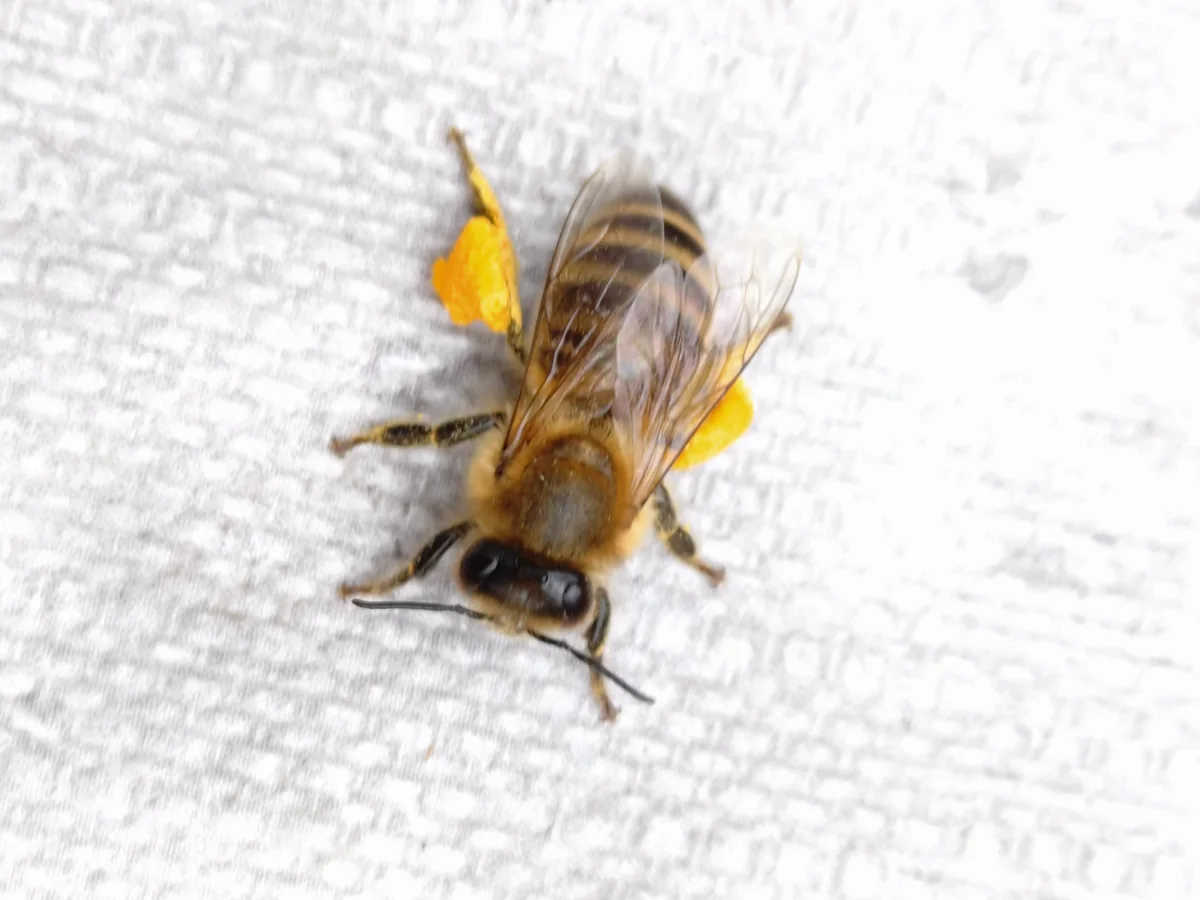
After foraging, a honey bee must find her way back to the hive. She uses several sources of information to navigate. The sun’s position can provide a directional reference; the polarisation pattern of skylight is also part of her celestial compass. It arises through the scattering of light in the atmosphere. This pattern is barely perceptible to our eyes in everyday life, but can contain useful directional information for a bee.
Landscape features and the panorama add to this. The route home is therefore more than a direction in the sky. Movement of the surroundings during flight also supplies information: this optic flow helps estimate the distance travelled. What we casually experience as passing scenery becomes part of the animal’s navigation. Returning to the hive brings together vision, experience and movement. No single sense explains it fully.
Why a UV photograph is not a bee’s-eye view
A UV photograph can reveal which areas of a flower reflect ultraviolet light. But it shows these differences on a screen or paper in colours that we can recognise. It is a translation. Simply tinting an ordinary photograph purple does not even provide that measured information.
Scientific models also work with translations and assumptions. Measured reflectance spectra and known receptor sensitivities can be used to calculate differences for the bee visual system. Research can thus examine which signals are likely to be distinguishable. It does not show us what a colour subjectively feels like to a bee. When interpreting such images, it helps to ask: was ultraviolet actually recorded, were measured values modelled, or was an effect merely applied to a photograph? Each representation may show something. What matters is that it is explained accurately.
Looking at a meadow afresh
On a mild day, choose a flowering plant and stand quietly beside it for a few minutes. If possible, watch one animal across several flowers. Record which flowers it approaches, where it lands and how long it stays. A photograph of the plant and a short note of the time are enough to begin. There is no need to catch or touch the animal.
Then examine a single flower closely: are there lines towards the centre, conspicuous stamens, or changes in colour and shape? You will not discover its UV pattern with the naked eye. But you can notice how much structure lies in something that was merely a patch of colour from a distance. When the next bee arrives, you still will not know her view. Yet you will know that she may find more, and different things, in the same flower than you do.
Sources & further reading
- USDA Agricultural Research Service: A Scanning Electron Microscope Atlas of the Honey Bee – Augen und Kopf
- DLR Insect Vision: Bee photoreceptor response model
- Chittka & Waser (1997): Why red flowers are not invisible to bees
- Orbán & Plowright (2014): Visuelle Signale beim ersten Blütenkontakt von Honigbienen und Hummeln
- Queen Mary University of London: Hummeln unterscheiden Duftmuster auf Blüten
- Universität Würzburg, AG Pfeiffer: Himmelskompass, Landmarken und optischer Fluss
- Vasas, Hanley, Kevan & Chittka (2017): Multispectral images of flowers reveal the adaptive significance of using long-wavelength-sensitive receptors for edge detection in bees
- Giurfa, Núñez, Chittka & Menzel (1995): Colour preferences of flower-naive honeybees