
A building material is secreted
Honey bees have wax glands on the underside of the abdomen. In workers producing wax, small, thin plates appear there. The animals retrieve these wax scales with their legs and bring them to their mouthparts. The material is worked further there and then used in construction. The often-used expression “sweating wax” vividly describes what is visible, but the material is not the same as human sweat.
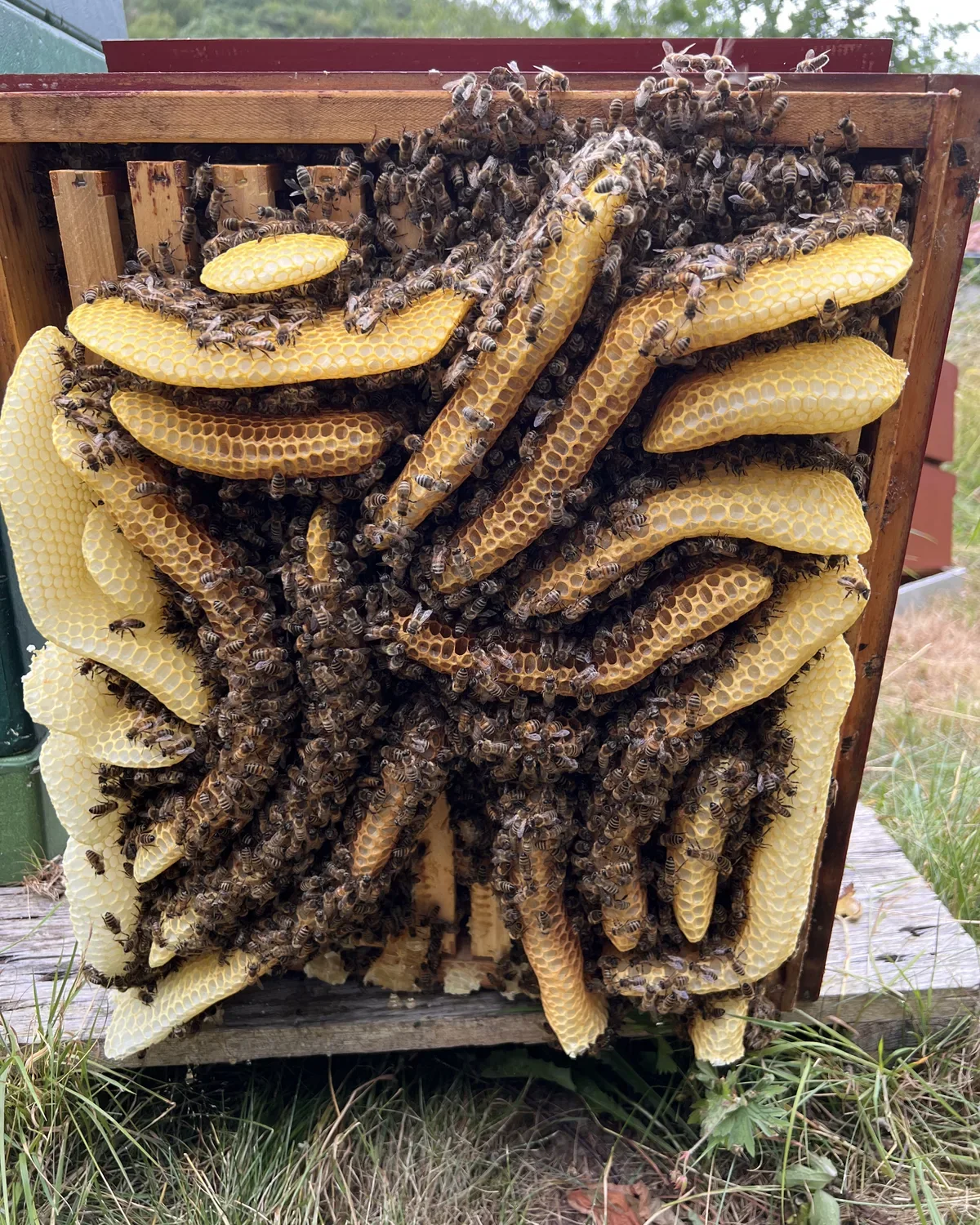
Newly formed scales are colourless and can look whitish in a mass. The familiar warm yellow develops only through further influences, such as constituents of pollen and propolis. A pale new comb and an older, dark brood comb therefore tell different material histories. Even colour can direct our attention to the time a comb has spent in the colony. It is not, however, a laboratory analysis of its composition.
The builder is not a permanent professional caste
Wax production is particularly associated with a phase in the lives of younger workers. The gland complex changes during their development. A 2024 study compared newly emerged, wax-producing and older workers. Differences in tissue structure, proteins and metabolites showed how strongly this organ is linked to the particular life stage. The capacity to supply building material resides in a changing body.
This does not make a building bee a separate species within the colony. She remains a worker whose contributions shift with age and need. A comb also involves more than the moment of wax secretion: material must be transported, attached, shaped and joined to what is already there. In the completed structure, we see the sum of these activities, not the work of one exceptionally skilful bee. The collective result outlives many of its builders.
A thin wall holds many possibilities
A honey bee comb has two usable sides. Cells extend to either side from a shared central zone; passageways for bees remain between neighbouring combs. Young bees develop in the cells, pollen and honey are stored there, and stores are sealed. The comb is also a surface on which bees live. Looking only at the stored honey therefore overlooks much of its importance.
Communication takes place on it too. A forager can dance here; other animals can move, make contact and share food. The building material thus shapes the colony’s living conditions and working surface. A cross-section makes this multiple use particularly clear: a remarkably small amount of material creates a large, subdivided interior. The individual cells are not isolated containers, but parts of a continuous structure.
Why so many hexagons fit together
Regular hexagons can fill a surface without gaps. Neighbouring cells share walls rather than each having a complete outer wall of its own. Space can thus be divided using relatively little building material. This geometric property helps explain why the comb’s form is so effective. It does not mean, however, that a bee must solve a mathematical problem before building.
Nor is a natural comb a flawless drawing. Different shapes appear at transitions, obstacles and areas of differently sized cells. The regular pattern is an underlying principle fitted to a particular spatial situation. The places where it changes are especially informative: they show that the animals must produce a connected structure. Perfection here does not mean looking the same everywhere, but making a construction that works under its conditions.
The shape arises through activity and material
Exactly how the hexagonal form develops is a subject of scientific investigation and discussion. Explanations have considered, among other things, behaviour when positioning new cells and the physical properties of wax. From this came the popular idea that bees simply build round tubes and heat turns everything into hexagons by itself. As a general explanation, that falls short.
Observations using video and thermal imaging have documented direct construction activity and challenged an origin through liquid equilibrium alone. Other studies investigate how the existing arrangement influences the beginnings of adjacent cells. Material properties and the animals’ actions therefore need to be considered together. A finished comb does not reveal the working process by itself. For that, we must watch bees as their structure emerges, rather than simply measuring the result.
What happens when the template does not fit?
In beekeeping, foundation sheets often provide an embossed wax surface on which bees continue building. A study published in 2025 investigated how flexibly they respond to unusual templates, using specially made foundations and X-ray microscopy. The prescribed cell sizes were altered. The bees could merge neighbouring cells, tilt their construction or create additional layers. Their result was not simply a copy of the template.
These experiments deliberately create unusual conditions. They do not prove that every natural comb develops in exactly the same way. But they demonstrate an important ability: the community can respond to a spatial problem with different structural solutions. That suits a nest whose needs change. Brood, stores and available space must all be accommodated. The comb’s regularity does not exclude adaptability; both are part of its achievement.
The material retains traces of its use
Beeswax is a complex mixture including esters, fatty acids, alcohols and hydrocarbons. Its properties make it easy to shape; at the same time, certain fat-soluble substances can accumulate in it. The origin and quality of wax therefore matter in beekeeping. A beautiful yellow block does not reliably reveal which residues or adulterants it contains. In cases of doubt, only suitable testing can establish that.
The Bavarian State Institute for Viticulture and Horticulture distinguishes, among other things, newly obtained wax and wax from older combs used for longer periods. Traceable origins, separate processing of suitable batches and quality control matter for responsible wax management. In the colony, wax is no arbitrary craft material: larvae develop in direct contact with its walls, and food stores lie within it. Care for this material begins by understanding it as part of the habitat.
Looking at a comb as a landscape
During a supervised opportunity to look inside, it is worth doing more than searching for the queen. Where does the completed structure end? Are there pale edges, irregular transitions or different cell areas? Can you distinguish open storage cells from capped areas? A photograph helps with later comparisons when details disappear amid the movement of bees. Your expert guide can explain what is actually visible.
Natural comb shows especially clearly how much spatial order emerges from collective work. From a distance it looks regular; close up, there are traces of growth, use and adaptation. This combination makes it so impressive. Many little bodies produce material and change their immediate surroundings. What remains is a structure in which other animals can live: a shared home, grown from the bodies of its inhabitants.
Sources & further reading
- LWG Bayern: Bienenwachs – Entstehung, Zusammensetzung und Eigenschaften (PDF)Wax glands, transport of wax scales, composition and colour development of beeswax.
- Xu et al. (2024): Proteome-metabolome profiling of wax gland complexInvestigation of developmental stages of the wax gland complex, its tissue and metabolism.
- LWG Bayern: BienenwachsComb as brood space, food store, living surface and communication platform.
- Bauer & Bienefeld (2013): Hexagonal comb cells are not produced via a liquid equilibrium processObservations of active comb construction and the formation of hexagonal cells.
- Gharooni-Fard et al. (2025): Honeybees adapt to a range of comb cell sizesExperiments with altered foundations and X-ray microscopy to investigate geometric adaptation of comb.
- LWG Bayern: Qualitätssicherung beim BienenwachsResidues in wax, differences between virgin and old wax, and traceable wax cycles.
- Scientific Reports (2016): The hexagonal shape of the honeycomb cells depends on the construction behavior of beesStudy of cell arrangement and construction behaviour when beginning new comb cells.