
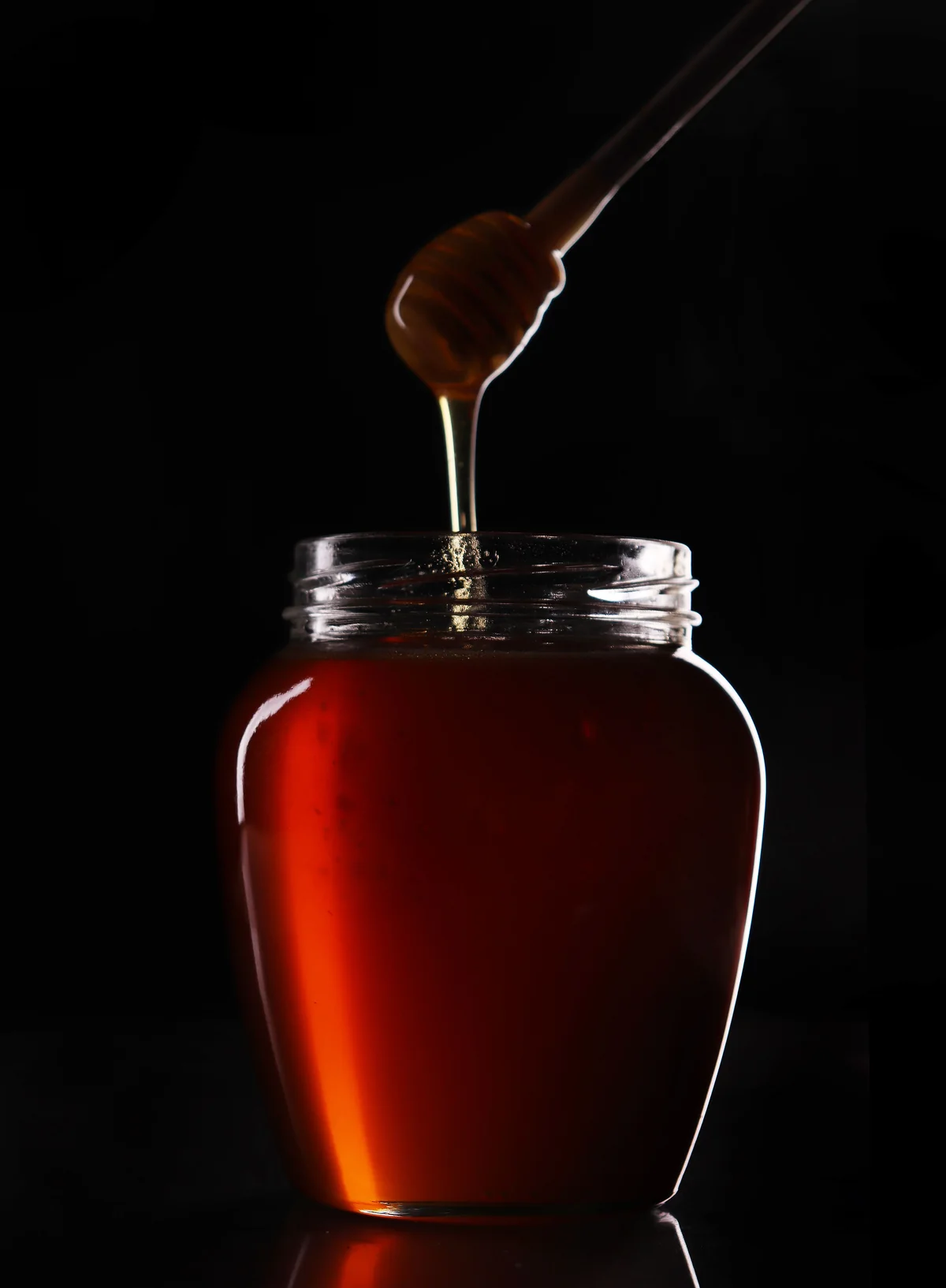
Not every honey begins in a flower
We see a bee on a flower and think of honey. The route is familiar: the plant offers nectar, the bee collects it and brings it back to the colony. But there is a second, more easily overlooked route. Insects that suck plant sap, including certain aphids and scale insects, live on twigs, needles and leaves. They release some of the sugars they take in as honeydew.
Honey bees can collect these sweet droplets. In the hive, the material is passed on, combined with substances produced by bees and concentrated. Honeydew becomes a store on which the colony can live. What later stands in the jar therefore connects a tree, a sap-feeding insect and the work of many bees. Honeydew is neither dew nor tree resin.
Honeydew originating in woodland can become forest honey. A colony at the forest edge alone does not, however, produce forest honey by definition. Bees use available food sources within reach. Flower nectar and honeydew can mix within a harvest. The colony’s location alone is therefore insufficient to establish the honey’s origin.
Dark is a colour, not yet a honey type
Many honeydew honeys are brown to dark brown and have a spicy, sometimes malty aroma. Nevertheless, not every dark honey is forest honey. Blossom honeys, such as sweet chestnut or heather, can also have strong dark tones. Even lime honey can range widely in colour, partly because the ratio of nectar to honeydew contributes.
Consistency also changes our impression. Fine sugar crystals scatter light and make a honey look lighter. Liquid and creamy honeys therefore cannot be compared solely by their visible brightness.
For a reliable botanical classification, specialist laboratories consider several characteristics together: the microscopic picture of pollen and other components, electrical conductivity, sugar composition and sensory impression. LAVES describes this combined assessment in detail. Colour can raise a question. The answer takes more than a glance through the jar.
A different starting point called Manuka
Manuka honey is made from nectar of the Manuka plant, Leptospermum scoparium. It is therefore a blossom honey. The abbreviation MGO, often found on the label, stands for methylglyoxal. This substance contributes substantially to the distinctive antibacterial activity of many Manuka honeys studied. Its content is usually expressed in milligrams per kilogram.
An MGO number therefore describes a concentration first of all. It does not tell us how good a honey tastes and does not by itself demonstrate a health benefit from eating it. Authenticity of origin is a separate question too: New Zealand’s MPI uses a combination of four chemical attributes and a DNA marker to test honey exported as Manuka. One number does not replace that overall picture.
Nor can other honey be reduced to a single mechanism. Concentrated sugar, acidity, hydrogen peroxide and other components can contribute to inhibiting bacteria in the laboratory, depending on the sample. Honeydew honeys in particular show how interesting the interaction between different substances can be.
Two studies that do not produce a simple ranking
Comparing European honeys with Manuka does reveal remarkable research. It becomes clearer when we consider the individual experiments.
What 23 Slovak samples showed
In a study published in 2018, a research team tested 23 Slovak honeydew honeys against two bacterial strains: Staphylococcus aureus and Pseudomonas aeruginosa. A Manuka honey labelled MGO 550 and a Kanuka honey served as comparators. In these tests, the honeydew samples inhibited growth to a comparable extent or, in some cases, more strongly.
The researchers also investigated the mechanism. Breaking down hydrogen peroxide markedly reduced the strong inhibitory effect. At the same time, the measured peroxide level alone did not fully explain differences between samples. The work therefore directs attention towards plant compounds and their interaction with peroxide. It reveals more than simply that honey contains a lot of sugar.
Why the 2024 comparison turned out differently
A 2024 study compared Polish honeydew samples with four commercial Manuka honeys. Of twelve Polish samples submitted, two had a questionable classification as honeydew honey; they were included as negative controls. Four bacterial species were tested.
In this experiment, the Manuka honeys on average achieved strong growth inhibition at lower concentrations, particularly against the two Gram-positive test bacteria. Individual honeydew samples nevertheless showed comparable results. The region of origin, honeys selected, test organisms and measurement methods differed from those in 2018.
These papers therefore do not yield an overall winner. A result applies to the samples studied under their particular conditions. The differences themselves show why treating “forest honey versus Manuka” as a blanket contest falls short.
What we observe in our own harvests
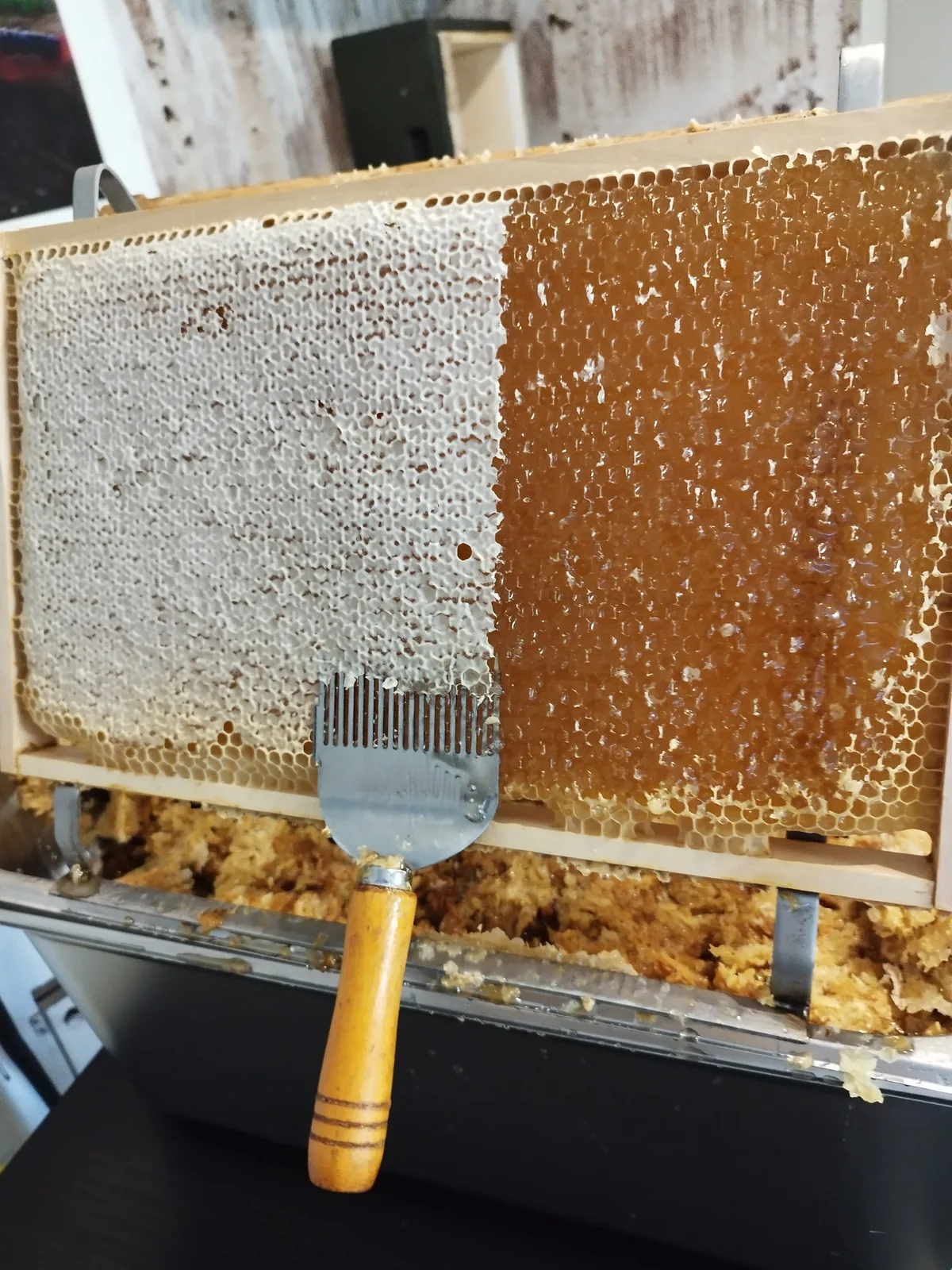
For us, the comparison begins closer to the apiary. Our Welterbe Frühling is very dark and strong in flavour. Welterbe Sommer 2026 is lighter. Kirchditmolder Frühling is also dark and still liquid in October 2026. Our apiary’s harvests can differ that much.
We suspect a honeydew contribution in the dark honeys. Without a confirmed botanical classification, we describe that suspicion as exactly that. A strong flavour and dark colour are good reasons to be curious. Alone, they are not enough to classify a honey as forest honey.
Johannes and Philipp Ballier care for the colonies, keep harvests from different sites separate, and process and jar the honey themselves. This allows differences to be discussed and origins traced. The names of our harvests initially tell a story of place and season. Their precise botanical composition is a further question.
A comparison needing only your own tongue
To get to know a honey, begin with a small amount on its own. Smell first, then taste and give the aroma a moment. Is sweetness the main impression? Do spicy, floral or malty notes follow? How does the honey feel on the tongue? These perceptions are personal. They need no claim of superior health benefits to be interesting.
Next, compare a second jar. A pale, finely creamy honey can be as distinctive as a dark, liquid one. On robust bread, with cheese or in a mustard vinaigrette, a honey reveals itself differently again. There is no reason to measure every jar against a single favourite flavour.
You can taste all our honey varieties at the Christmas market at the Waldorf school in Kassel. There you can compare the harvests directly and ask us about their origins.
Plenty of reasons for a good jar
The comparison with Manuka opens a fascinating view of European honeydew honeys. It shows how much research lies even within a familiar food. At the breakfast table, however, something else may guide the choice: a taste you enjoy and an origin you can ask about.
Perhaps the next dark jar will bring to mind a tree and the tiny insects on its branches. From there to your bread was a long journey. Its story runs from the foraging flight to the person who filled the jar.
Sources & further reading
- Bayerisches LGL: Honige – Nektar, Honigtau und Produktgruppen
- LAVES: Die Farbe des Honigs
- LAVES: Sortenhonig – botanische Herkunft und SortenbeurteilungEspecially page 2: combined assessment of sensory properties, pollen profile and chemical and physical characteristics.
- New Zealand MPI: Ensuring mānuka honey is authentic
- Kwakman et al. (2011): Two major medicinal honeys have different mechanisms of bactericidal activity
- Bucekova et al. (2018): Phytochemicals-mediated production of hydrogen peroxide is crucial for high antibacterial activity of honeydew honeyLaboratory investigation of 23 Slovak honeydew samples; not evidence of a health effect from eating them.
- Grabek-Lejko et al. (2024): The comparison of the antioxidant, antibacterial and antiviral potential of Polish fir honeydew and Manuka honeysLaboratory comparison of Polish samples with four Manuka honeys; two questionable Polish samples included as negative controls.