

A honey bee colony does not live on sugar alone
Nectar and pollen take centre stage in many stories about bees. Water easily remains invisible, although bees need it themselves and use it for various tasks in the nest. It helps with processing stores and is part of providing for brood. Nest humidity also plays a role in development. A water source is therefore more than an optional extra for particularly hot afternoons.
Demand depends on the colony’s situation. How much brood is being raised, what food is coming in and how warm the nest is all change the task. A blanket daily figure in litres would hide these differences. Anyone seeing a bee on damp earth should therefore not dismiss her visit as aimless crawling. A barely visible film of water may have a direct connection to a colony’s nursery.
A small load for many receivers
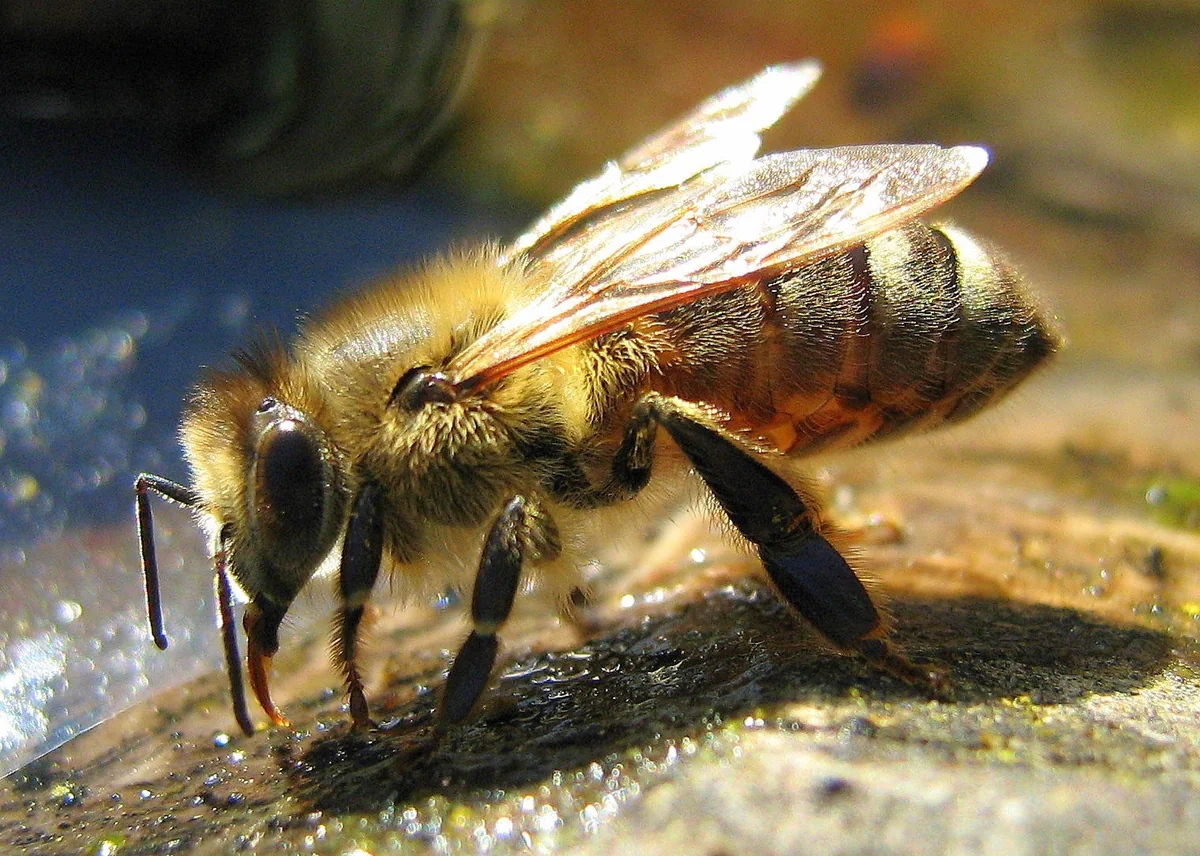
Water foragers take up liquid through their proboscis and transport it in the honey stomach, also called the crop. This part serves as a carrying container. Its name does not mean that everything inside must become honey. In the colony, liquids are passed between workers and used as required. The individual forager’s contribution takes on its meaning through this distribution.
Water is stored differently from ripe honey. A colony has no large, permanent water reservoir comparable to its energy stores. Nevertheless, saying that water is never stored temporarily is too strict: in heat-stress experiments, researchers found temporary reserves both in workers’ crops and in comb cells. A small reserve can bridge a gap; when demand is high, ongoing supplies must quickly replenish it.
Water becomes cooling
When the brood nest gets too warm, bees have several behaviours available. They can move air with their wings and use water for evaporation. Turning liquid water into water vapour absorbs heat. We encounter the same principle when air passes over wet skin. For the colony, obtaining water, distributing it and moving air work together.
The individual bee on the stone is therefore part of a task deeper inside the nest. Her load need not cool her own body; it may benefit other bees and the brood. The colony’s shared temperature regulation can scarcely be followed in full from outside. At the water source, however, one part of the relationship becomes visible. Every return links a place outside the hive to conditions on the comb. Good supplies and a suitable nest climate are closely connected.
How does a forager know water is needed?
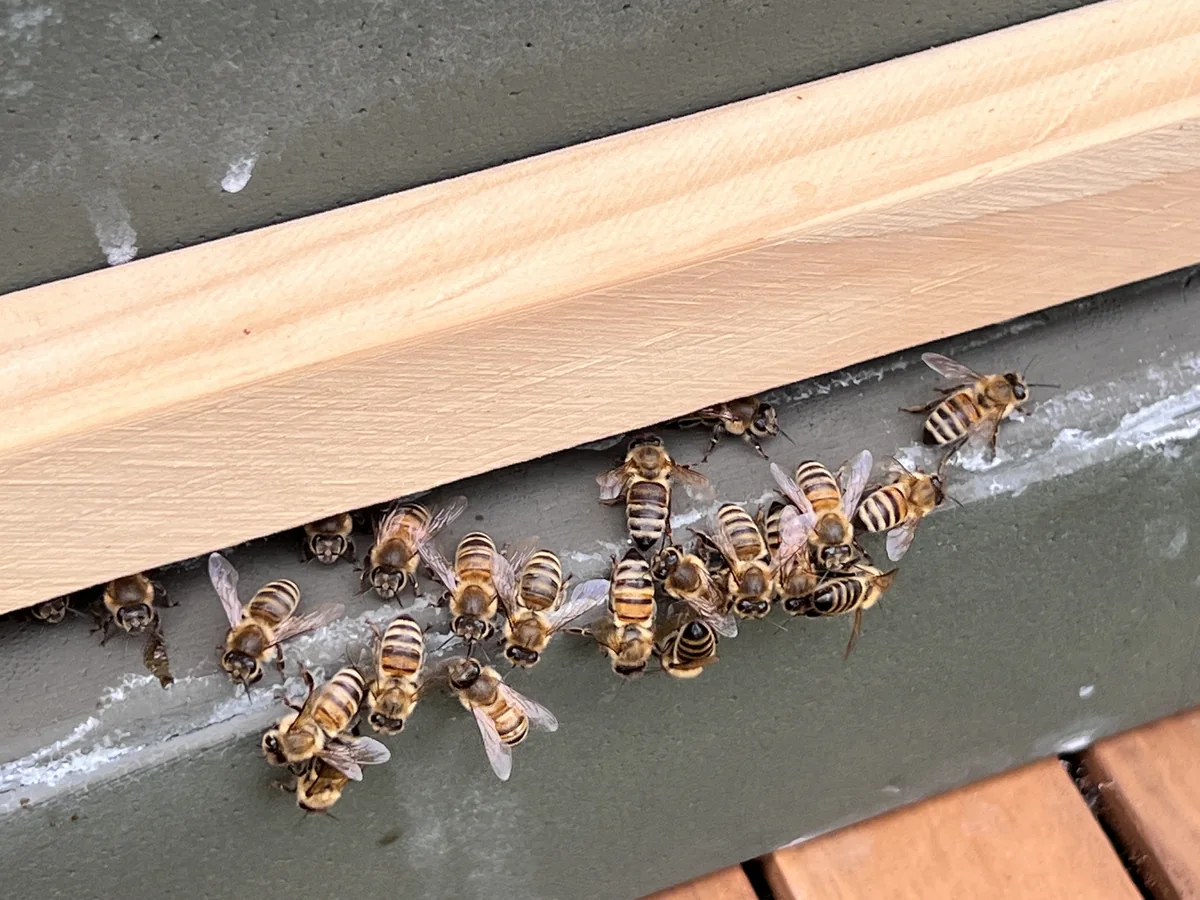
Water foragers need not inspect every brood cell before responding. In 2016, Ostwald, Smith and Seeley studied how colonies adjust their water collection when the brood nest overheats. More requests for liquid from nestmates and the foragers’ own thirst can signal that their work is needed again. The state of the community becomes apparent through contact between its members.
This is a concrete form of collective regulation: an animal responds to the situation it directly perceives, and its behaviour changes supplies for others. The experiments show adjustment under the stresses examined. They do not turn the bee into a conscious technician with an overview of every temperature. Yet a coordinated response arises without such a central control room. Demand reaches the workers obtaining water outside through many encounters.
Why this particular puddle?
People are often surprised when a bowl of clear water attracts less attention than a puddle or damp surface. Minerals can influence the choice of a source. Lau and Nieh studied water foragers’ responses to different salt solutions and analysed water sources they visited. The bees responded differently depending on the salt and concentration; individual bees also showed different preferences.
The observation therefore cannot be reduced to “bees like dirty water”. Cloudiness reveals neither the composition nor the suitability of a source. Nor does a laboratory experiment produce a universal mixing recipe for a garden water station. What is interesting is that, from a bee’s perspective, a seemingly simple liquid can have different properties. What looks like interchangeable water to us offers different stimuli to them. Their choice does not necessarily follow our idea of an appealing drinking spot.
A proboscis needs a safe foothold
Taking in water while staying dry is a challenge in its own right. On a damp surface, a bee can find firm footing while reaching the liquid with her proboscis. A deep open bowl does not offer that support everywhere. This favours accessible shallow margins and landing surfaces from which bees can reach the water. The design of the transition is often more important than the vessel’s size.
Honey bees are not, however, completely helpless in water. In a study, Roh and Gharib showed that bees landing on the water surface can generate propulsion with their wetted wings. This unusual movement is no substitute for safe access. Wet wings can make taking off difficult, and a water source should not demand such effort. The interesting finding corrects a simple “bees can do nothing in water” without making a hazard into a suitable place to stay.
A simple water station needs care
A shallow, stable vessel with rough stones or other secure supports projecting above the water suits a small water station. Bees should be able to reach moisture from them. This connection must remain as the water level falls. A decorative stone in the middle is of little use if a deep, open moat surrounds it and the edge offers no access.
Utah State University recommends shallow water with safe landing places and regular renewal. That includes keeping the vessel clean and checking it during dry weather. In a garden, such a provision complements flowers and suitable habitat features; it does not replace them. Watching the water station lets you learn about its use without handling animals. Identifying visitors is worthwhile too: not every yellow-and-black insect is a honey bee, and different animals may share the same damp edge.
What water stations can offer
A Canadian field study tested supplied water stations in agricultural landscapes. Bees used them, and the water provided contained fewer pesticides than other sources examined. The risk of drowning was also lower. At the same time, these experiments found neither reduced worker mortality nor an increase in total colony weight. Useful access is therefore not automatically evidence for every hoped-for benefit.
This distinction does not diminish water’s importance. It helps us look more precisely: what do animals actually use, what does an intervention change, and what remains uncertain? A puddle’s edge offers a glimpse of this. The bee quietly lowering her proboscis there is supplying a world we cannot currently see. When she flies away again, she carries no conspicuous pollen package. Her work is nevertheless on board.
Sources & further reading
- National Bee Unit: Feeding bees – water (PDF)Functions of water in a honey bee colony, uptake from damp surfaces and suitable access to water sources.
- Ostwald, Smith & Seeley (2016): The behavioral regulation of thirst, water collection and water storageFeedback on demand, water foraging and small temporary water reserves under heat stress.
- Lau & Nieh (2016): Salt preferences of honey bee water foragers (PDF)Study of water foragers’ salt preferences and differences with salt type, concentration and individual.
- Roh & Gharib (2019): Honeybees use their wings for water surface locomotionStudy of honey bees moving on water with the help of wetted wings.
- Utah State University Extension: What Do Honey Bees Eat? – Do Bees Drink Water?Advice on shallow, clean water, safe landing places and regular renewal of bee water stations.
- McCune et al. (2021): Supplying honey bees with waterersField study of bee water stations, pesticide content and drowning risk. Worker mortality and colony weight did not demonstrably improve in these experiments.