

What a flower gives the colony
Pollen is part of the reproduction of flowering plants. For bees, it is also an important food source. While nectar and honey primarily provide energy, pollen contributes proteins, fats and other nutrients essential for development. Its value therefore lies somewhere different from the sweet stores above the brood nest. A colony needs both: fuel for everyday life and building blocks for growing bodies.
Pollen is not a uniform ingredient. Its composition differs between plant species. The colour of a stored parcel alone reveals neither its precise origin nor its nutritional quality. The colourful mosaic is visible evidence of foraging work. Reliable botanical identification needs closer examination, often under a microscope.
A food store travels on two hind legs
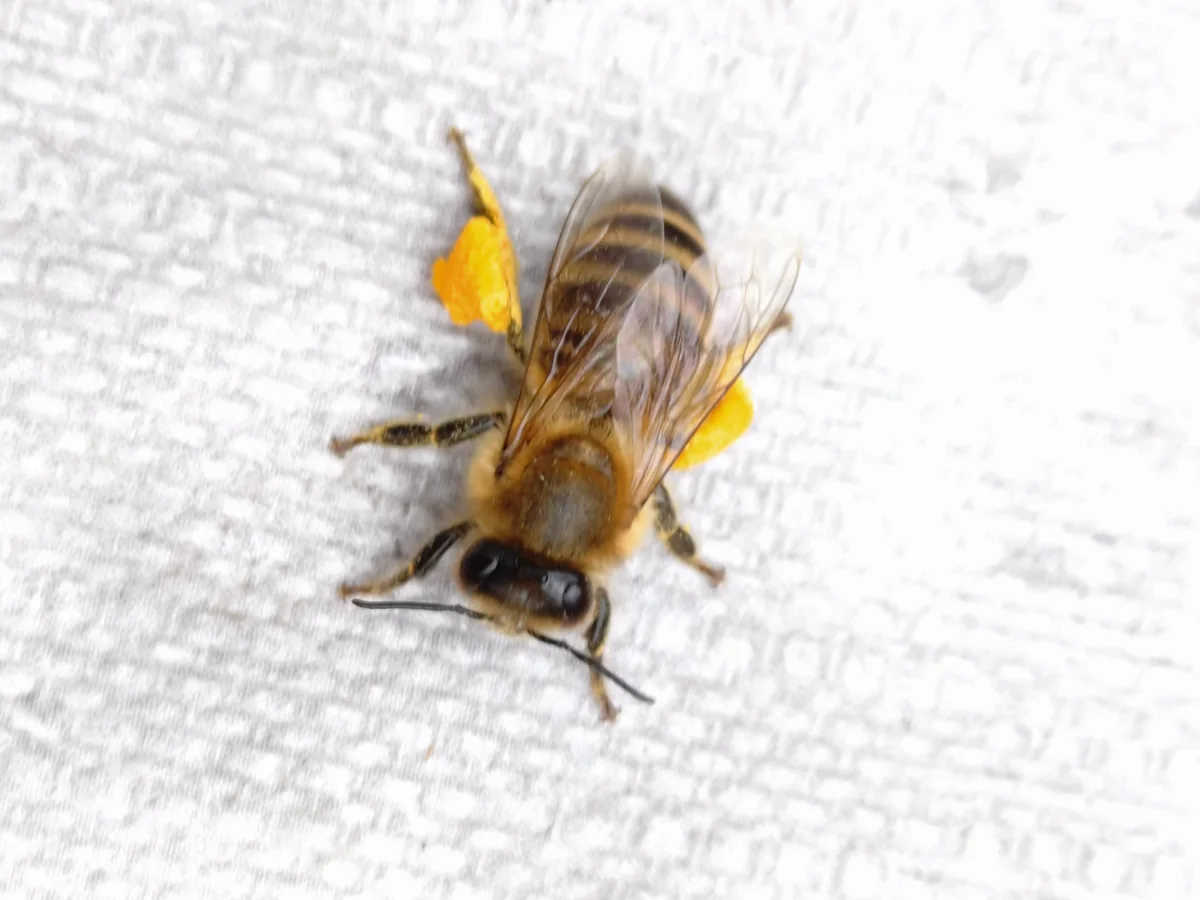
During a flower visit, pollen sticks to the hairs on a bee’s body. A foraging worker brushes grains together, moistens them with liquid from her honey stomach and forms parcels. These sit on the collecting structures of her hind legs. The familiar pollen loads are therefore not body parts but cargo ready for transport. At the hive entrance, you can see how varied the returning parcels are in size and colour.
Different things are happening for the plant and for the colony. Loose grains on the body can contribute to pollination during further visits. The tightly packed pollen on the legs, by contrast, is carried home as food. A single animal thus connects two stories: the plant’s reproduction outdoors and the community’s food supply in the dark.
Parcels become filled cells
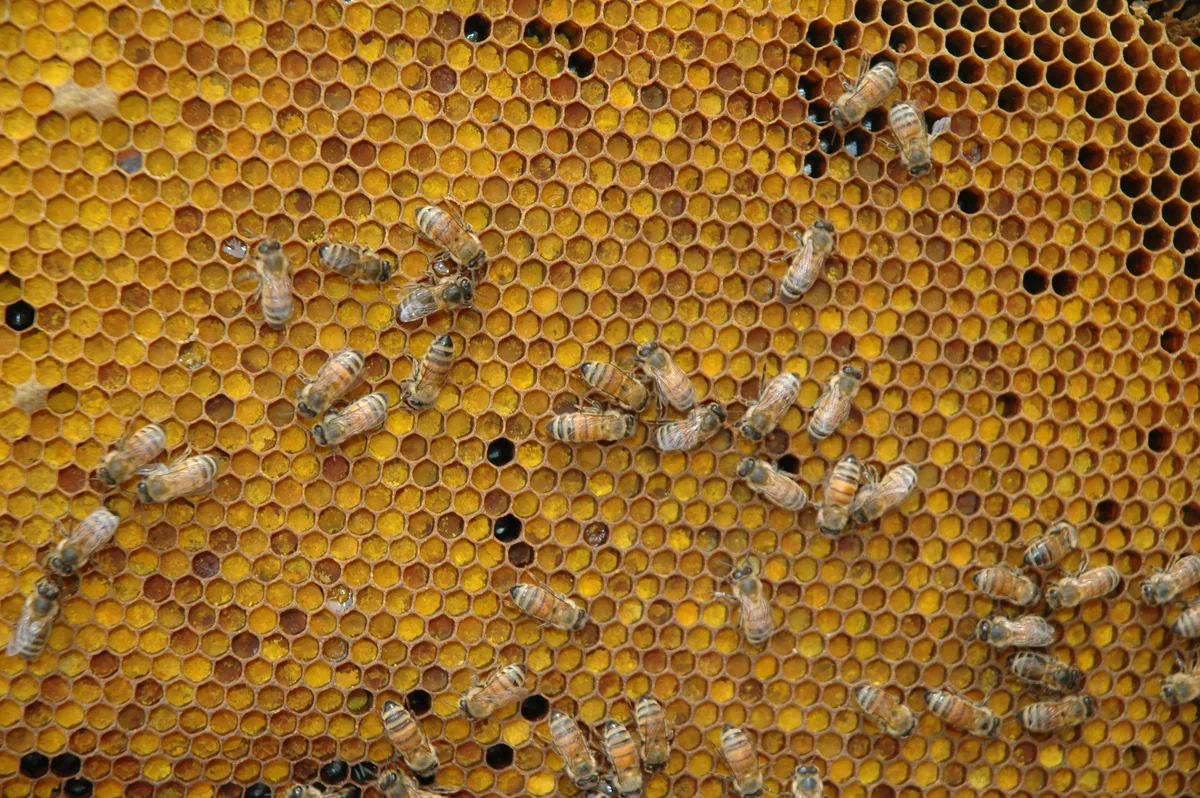
In the hive, the collected pollen is deposited in comb cells and pressed down. Nectar or honey and bee secretions are added. This produces the stored pollen that beekeepers call bee bread. Several deposits can lie on top of one another. A cut-open cell may therefore reveal layers: small deliveries from different flights, packed into a few millimetres.
Many of these stores lie close to the brood area. This shortens the journeys for those consuming food and caring for offspring. Yet the comb is not a fixed storage plan. Cells are filled, emptied and reused. A single image shows one moment in this traffic, not the colony’s entire diet.
The next generation eats by an indirect route
Young workers in particular consume large amounts of pollen. It supports their own physical development and the development of the glands that later produce brood food. Nurse bees use this to feed larvae and provide for other colony members. Between the flower visit and a growing bee’s body, there is therefore a stage of processing inside adult bees.
This explains why a full honeycomb alone does not mean complete nutrition. Sugar can meet energy needs, but cannot simply replace the nutrients in pollen. The nursery depends on a network of foragers, storage cells and nurses. When we look at a comb, we can easily overlook food that has already become invisible: consumed, transformed and passed on as brood food.
How microorganisms are involved in the stores
It is often said that pollen must first ferment for a long time in the hive before bees can use it at all. Studies in honey bees do not support this simple account. In 2014, Anderson and colleagues found only low microbial biomass and no evidence of extensive bacterial breakdown of the stored grains. Their results primarily support a preservative environment created by sugar, acidity and other properties of the stores.
This does not mean that bee bread is sterile or that no microbial processes take place. It means that the presence of microorganisms does not in itself prove essential predigestion. Fermentation and preservation answer different questions. A sweeping account of long-matured bee bread as nutritionally superior in every case goes beyond the reliable findings.
Nicolson and colleagues likewise found no improvement in digestibility through storage when comparing fresh and stored sunflower pollen. The subjects were young honey bees under controlled conditions. Such results do not replace a complete description of every type of pollen and every colony. They are sufficient, however, to question the supposed basic rule that pollen must be stored for a long time before becoming digestible.
Bees do not always wait for maturity
Carroll and colleagues observed how honey bees used pollen stores of different ages. The animals preferred freshly stored pollen. In supplementary feeding experiments, the storage ages studied showed no corresponding advantages in body mass or the gland characteristics examined. Older stores were not therefore worthless; they were simply less preferred.
This is crucial to understanding the comb. Food can be needed soon after being stored. What remains longer can serve as a reserve. The community follows no fixed recipe with a prescribed waiting time. It must reconcile ongoing brood care with fluctuating supplies. How quickly cells are emptied therefore also depends on demand and the available forage.
Not every colourful mixture is automatically the best
Pollen nutrition experiments show that botanical origin and food quality can make a difference. In the study by Di Pasquale and colleagues, diversity had different effects depending on the condition of the bees being studied. A mixture was not consistently better than every single pollen type for every measure. Here good science replaces an appealing slogan with a more precise question: what food is available to which bees, under which conditions?
For the landscape, a varied supply of flowers available throughout the season remains valuable. It offers choice and helps bridge periods with little food. Watching a pollen forager therefore reveals more than yellow luggage. She carries a piece of the flowering landscape into the nursery. Bee bread really begins long before the comb: wherever flowers open at the right time.
Sources & further reading
- Anderson et al. (2014): Hive-stored pollen – preservation, not nutrient conversionPrimary study: microbial biomass, pollen grain structure and the preservative environment of stored pollen.
- Carroll et al. (2017): Honey bees preferentially consume freshly-stored pollenComparison of storage age, consumption and developmental characteristics in freshly and longer-stored pollen.
- Di Pasquale et al. (2013): Do pollen quality and diversity matter?Primary study: pollen-dependent nurse physiology and the context-dependent benefits of mixed pollen.
- Di Pasquale et al. (2016): Variations in the Availability of Pollen Resources Affect Honey Bee HealthPrimary study: quantity and seasonal quality of pollen resources and the development of young workers.
- Nicolson et al. (2018): Digestibility and nutritional value of fresh and stored pollenPrimary study in young honey bees: storage did not improve the digestibility of the sunflower pollen examined.