
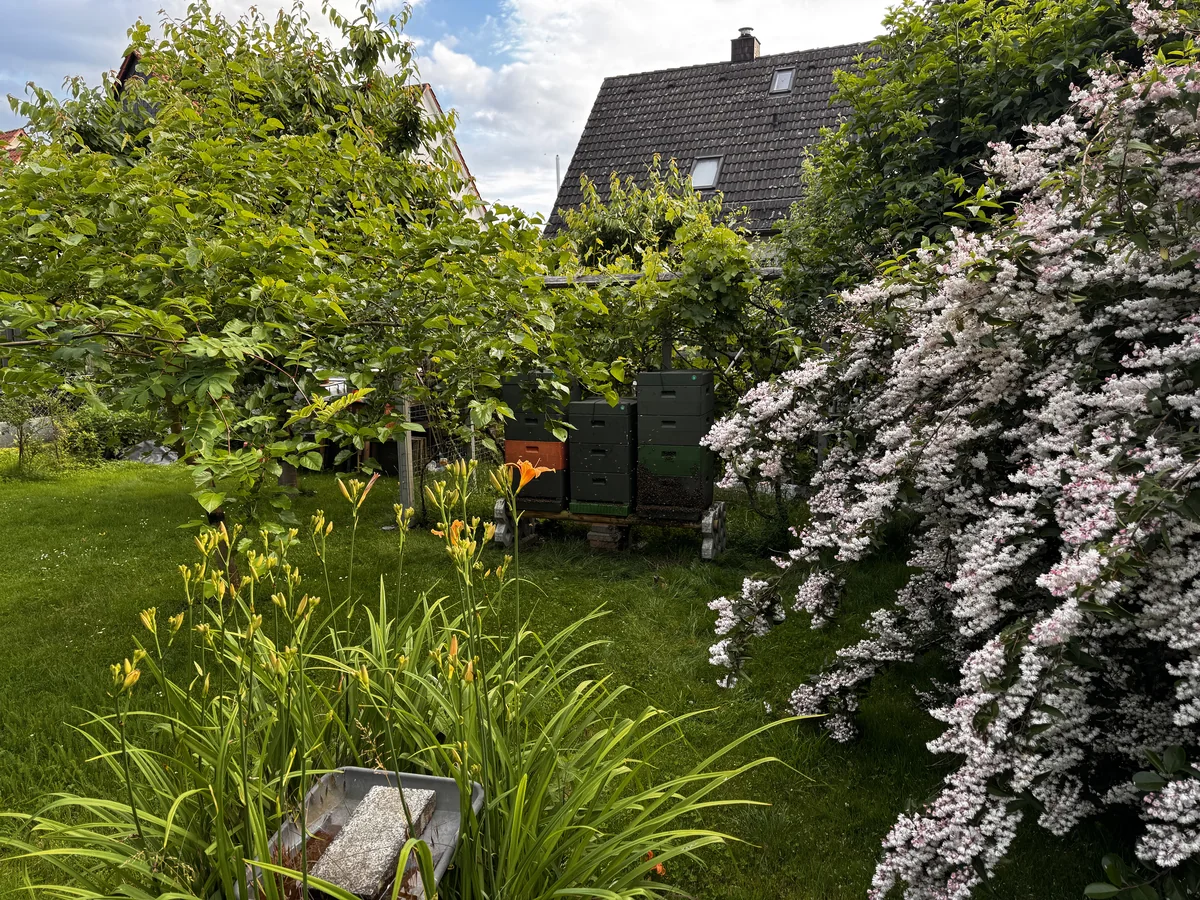
One name, many different lives
The western honey bee lives in a large, perennial colony. In beekeeping, people tend this community, monitor its health and help it through times of food shortage. Wild bees, by contrast, comprise many different species. Most are solitary; alongside them are social species such as bumblebees. Food, nesting places and flight periods differ considerably.
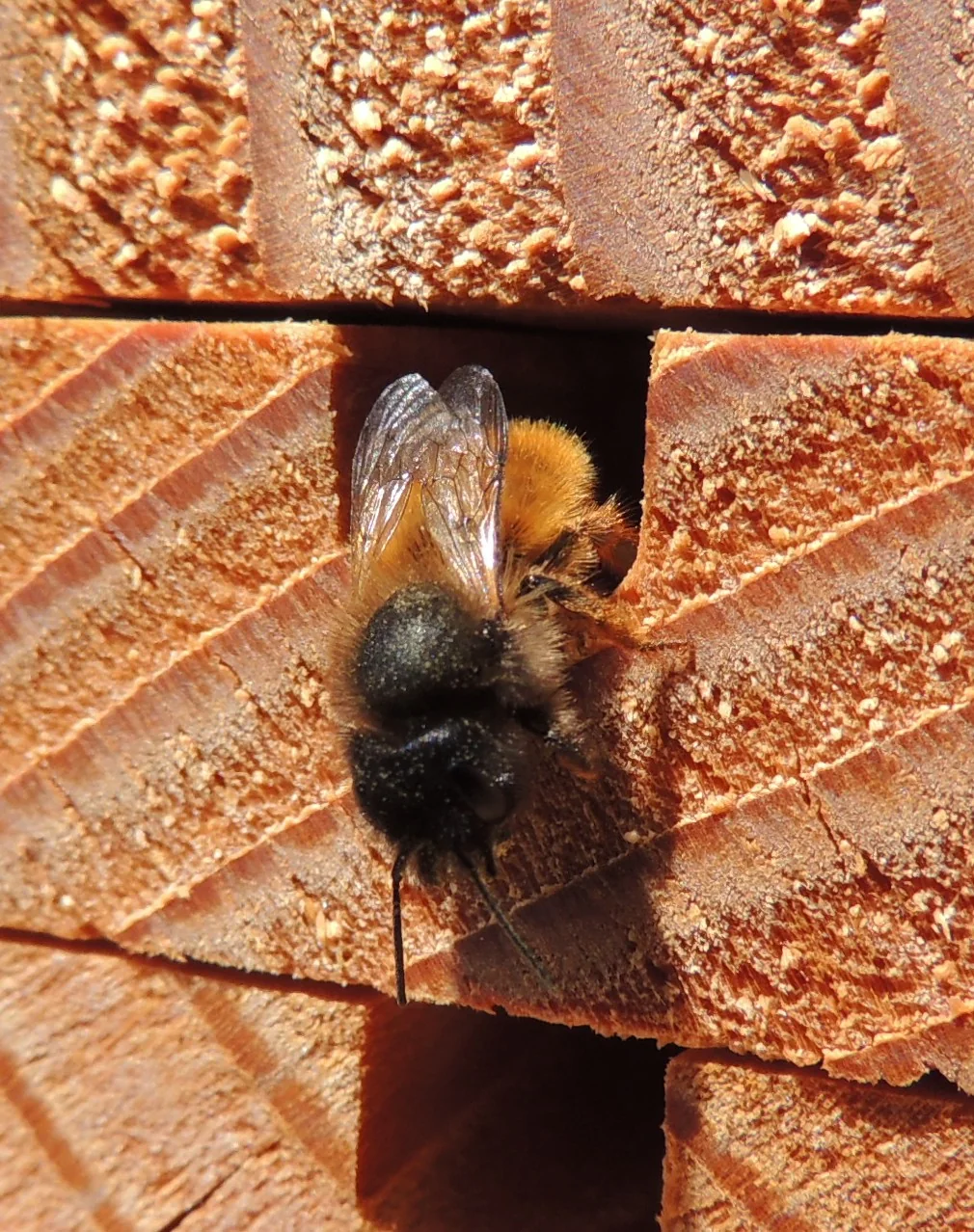
Pollen is particularly important for the next generation. Some wild bees can collect it only from particular plant families or even more narrowly defined plant groups. For these specialists, what matters is whether their precise food plants grow within reach. A managed honey bee colony and an individually nesting wild bee therefore respond very differently when a flower-rich area disappears.
_(8928109076).jpg)
Competition needs no quarrel
Competition for food usually looks unremarkable. One bee takes nectar or pollen, leaving less initially for the next visitor. No direct confrontation is needed. Where food requirements overlap, high numbers of foraging honey bees can reduce the supply available to other flower visitors. What matters is whether food actually becomes scarce.
A systematic review by Mallinger and colleagues found highly varied results for competition: many studies reported negative effects, while others found none or mixed effects. The authors also emphasised that direct consequences for reproduction and long-term populations had often not been measured. Shared flowers alone therefore do not prove population decline. But they show where closer investigation is needed.
What a study in Munich showed
In a large Munich garden, a research team compared visits to the same plant species over two years. When honey bee numbers increased from May in the second year, visitor proportions changed on several plants. All the statistically detected shifts there were in favour of honey bees. The study thus supports the assumption of competition for floral resources.
Its scope also has limits: particular plants were studied in one place over two flowering seasons. No figure for a tolerable number of colonies valid for every city can be derived from that. The finding is a reason to take local pressures seriously. It replaces neither investigation of other habitats nor long-term data on how many offspring individual wild bee species actually produce.
The surroundings are the right scale
A fruit tree full of blossom in spring says little about conditions around an apiary in July. In 23 Zurich gardens, researchers studied wild bees and honey bees on four standardised plant species. In this investigation, beekeeping intensity had no direct, statistically detectable effect on wild bee species richness or the partitioning of feeding niches examined. The local supply of plants, by contrast, played an important role. Direct food competition apparently was not a major driver of the wild bee community here.
This does not provide a general all-clear. The team recommends monitoring food resources across space and time and including changes in wild bee communities. In practice, that means noticing not only new colonies but also gaps in flowering, dry periods and changes in land. A general idea of the “green city” is too coarse to assess individual sites reliably.
Wild bee conservation begins with their habitats
An additional honey bee colony does not create a nesting place for a mining bee or a suitable pollen plant for a specialist. Anyone wishing to support wild bees therefore starts directly with their needs: native food plants, suitable patches of bare ground, retained stems and dead wood, and management that does not remove these structures while they are in use. The flower supply should sustain them through as much of the season as possible.
Beekeeping and wild bee conservation can meet in their concern for flower-rich landscapes. Their specific tasks nevertheless remain different. Improvements are particularly valuable when guided by the species occurring locally. A single heavily visited plant or densely occupied nesting aid each tells only one part of the story of the whole community.
Responsibility also means respecting limits
When planning a new apiary, discussion with other beekeepers and local conservationists is worthwhile. Where are colonies already located, what food is available, and are there sensitive habitats with rare wild bees? Decisions in and near such areas require particular care. More honey bees are no general measure of greater biodiversity.
Meanwhile, practical action can begin in the garden or on the balcony: add flowers, retain nesting places and observe changes. The aim is a landscape that supports different ways of life. Someone seeing both visitors on the knapweed need not choose which one to care about. They can learn to take their differences seriously. From this grows a care that extends beyond the familiar image of the beehive.
Sources & further reading
- Deutsche Wildtier Stiftung: Wildbienen und die HonigbieneDifferent ways of life, pollen requirements and nesting places; context for food competition.
- Mallinger, Gaines-Day & Gratton (2017): Do managed bees have negative effects on wild bees?Systematic review: variable findings on competition and gaps in research into direct long-term population effects.
- Renner et al. (2021): High honeybee abundances reduce wild bee abundances on flowers in the city of MunichComparison of flower visits over two years in a Munich garden; specific evidence of resource competition.
- Casanelles-Abella et al. (2023): Low resource availability drives feeding niche partitioning between wild bees and honeybees in a European cityStudy in Zurich gardens: importance of local and landscape resource availability; recommendation for monitoring over time.
- Bundesumweltministerium: Hilfe für Insekten am Haus und im GartenHabitat support through food plants, bare ground, dead wood and retained plant parts; spatial relationships between required resources.