
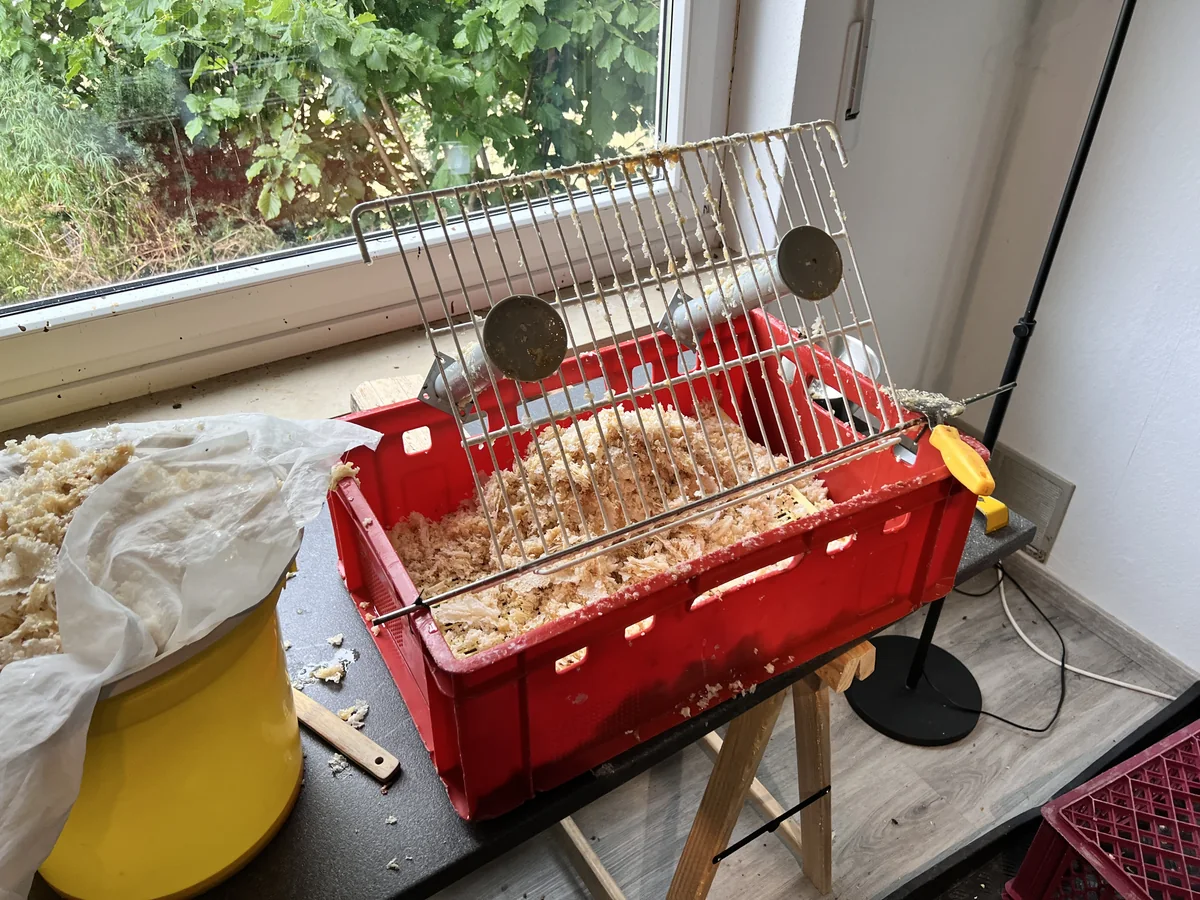
The first task is to wait
Honey is made in the colony itself. Foragers bring nectar or honeydew; hive bees process it further and remove water. What goes into the extractor should have undergone this ripening process sufficiently. A full comb alone is no reliable proof of that. Nor can a warm day or a particular calendar date replace checking.
The colony’s food supply is part of the decision. Honey is, first and foremost, its own energy reserve. How much can be taken therefore cannot be determined independently of colony condition, season and further food availability. A responsible harvest begins by looking at the bees, not by aiming for as many full buckets as possible. The following steps describe the usual route for extracted honey; details differ between beekeeping operations.
What a wax capping reveals, and what it does not
Bees close many sufficiently processed honey cells with a thin wax capping. These capped areas give an important indication of the comb’s condition. But they are no comprehensive measurement record. Even capped honey can contain too much water under unfavourable conditions. Conversely, ripe honey may still be in open cells.
A honey refractometer determines water content from the refraction of light through a sample. Correct calibration, sampling and handling all matter. Water content is important because honey that is too moist is more likely to ferment. Here a measurement helps more than a beautiful surface. LWG’s specialist advice therefore explicitly describes the limitations of the proportion capped and of simple tests on the comb.
The comb moves to a different workplace
For harvesting, suitable honeycombs are removed and cleared of the bees sitting on them. Several methods are available, such as bee escapes or careful brushing. The appropriate method depends on the management system and situation. Brood combs do not simply belong in the same workflow as honeycombs ready for harvest. The nursery remains a different responsibility from food production.
From this point, protected transport and a clean, dry workplace matter. Containers and equipment must be food-safe and cleaned. Honey absorbs moisture and foreign smells; an open bucket is therefore not an indefinitely patient temporary store. The journey from colony to processing should preserve the quality already present. Careless hygiene can compromise what the bees have already achieved.
A thin layer releases the stores
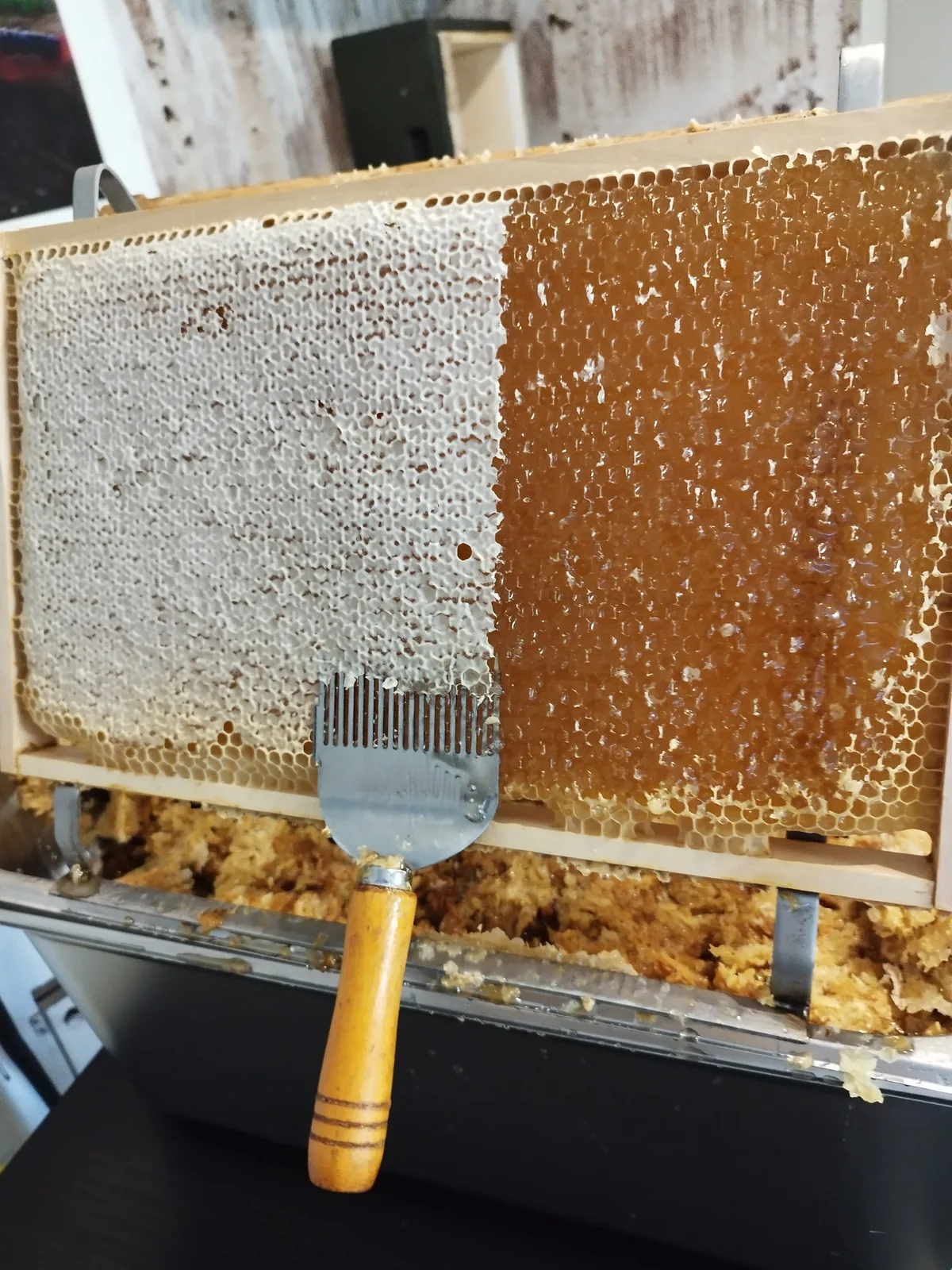
Before extraction, the sealed cells must be opened. An uncapping fork or suitable knives lift or cut away the wax layer. Beneath it, the honey appears. Good work opens the cells as completely as possible without cutting unnecessarily deeply into the comb. The frame is held so that dripping honey can be caught.
The removed cappings wax contains honey. It is collected separately and processed further. Here the two main products of the comb become visible again: the vessel built by bees and its contents. In the usual centrifugal extraction process, the honey harvest primarily empties the vessel. The comb structure can remain intact and, if suitable, later be used again in the colony.
Rotation separates honey from comb
In the honey extractor, the opened combs are set in motion. Rotation draws the honey out of the cells, onto the vessel wall and down to collect at the bottom. It can be collected through the outlet tap. The extractor therefore does not press the whole comb into a pulp. It uses movement to recover the flowing contents from the wax structure.
Rotational speed, the load on the combs and the design of the equipment must match. Work is especially gentle at the beginning, so that combs do not break under the weight of their contents. Some honeys present particular challenges: heavily crystallised honey cannot simply be extracted in the same way as liquid honey. A method is therefore no promise that every comb can be emptied the same way at any time.
After the golden stream comes patience
Freshly extracted honey may contain small particles of wax. Suitable strainers retain these particles. Rest then helps: fine particles and trapped air can rise to the surface and be skimmed off. Straining and settling are thus different steps with the same aim of carefully preparing the honey for further processing.
Tools and surroundings remain as important as time. Dry conditions, suitable closed containers and protection from foreign odours prevent the pause from creating new problems. LWG devotes a separate guidance sheet to cleaning and checking honey jars. Even beautifully settled honey needs a clean, undamaged, dry container if a harvest is to become a good jar of honey.
Creaminess does not come from a secret ingredient
Many honeys crystallise after harvesting. Composition and storage conditions are major influences on how quickly this happens and what structure develops. Stirring guides the crystallisation process: the developing crystals are distributed so that a uniform, fine texture can be achieved. A creamy consistency can thus result from careful handling of the honey without adding other ingredients.
Other honeys remain liquid longer because of their composition. Either state can suit the particular honey. Appropriate processing follows the product and its condition, rather than a single timetable for every harvest. Unnecessarily intense or prolonged heating should be avoided. Quality here means preserving what is already there and achieving a pleasant texture.
A jar is the final visible step
At bottling, the prepared jars are checked, filled and carefully sealed. Harvesting also involves records that allow a batch to be identified later. Suitable storage then protects against heat, light, moisture and odours. Attention does not end with tightening the lid. Honey remains a product whose condition depends on how it is handled.
Next time you open a jar, you can recognise a whole sequence of work within it: flower visits, ripening in the hive, checking, uncapping, extracting and careful handling. The striking stream of honey from the extractor is only one transition in this story. The bees made the honey. The beekeeper’s task is to harvest it with knowledge and preserve its qualities on the way into the jar.
Sources & further reading
- LWG: Von der Wabe bis ins Glas – Honigkurs, Modul 2Original training material: uncapping, extracting, settling, crystallisation, handling and storage.
- LWG: Problem – Zu hoher Wassergehalt im HonigSpecialist information on water content, honey ripeness and the limitations of simple ripeness tests.
- LWG: Entnahme von HonigwabenOriginal guidance sheet: harvest timing, comb removal, removing bees and checking ripeness.
- LWG: Produktionstechnik HonigOriginal technical material: honey processing, the principle of extraction and careful handling.
- LWG: Reinigung von HoniggläsernOriginal guidance sheet: cleanliness and preparation of honey jars.