
.jpg)
A bee with a different plan
Many female wild bees build brood cells, collect pollen and nectar, and leave provisions for each egg. Cuckoo bees make use of this groundwork. Their females lay eggs in the nests of suitable host bees. The name recalls the bird that also entrusts its young to others. The similarity describes a reproductive strategy; it does not mean that all bees given this name are particularly closely related.
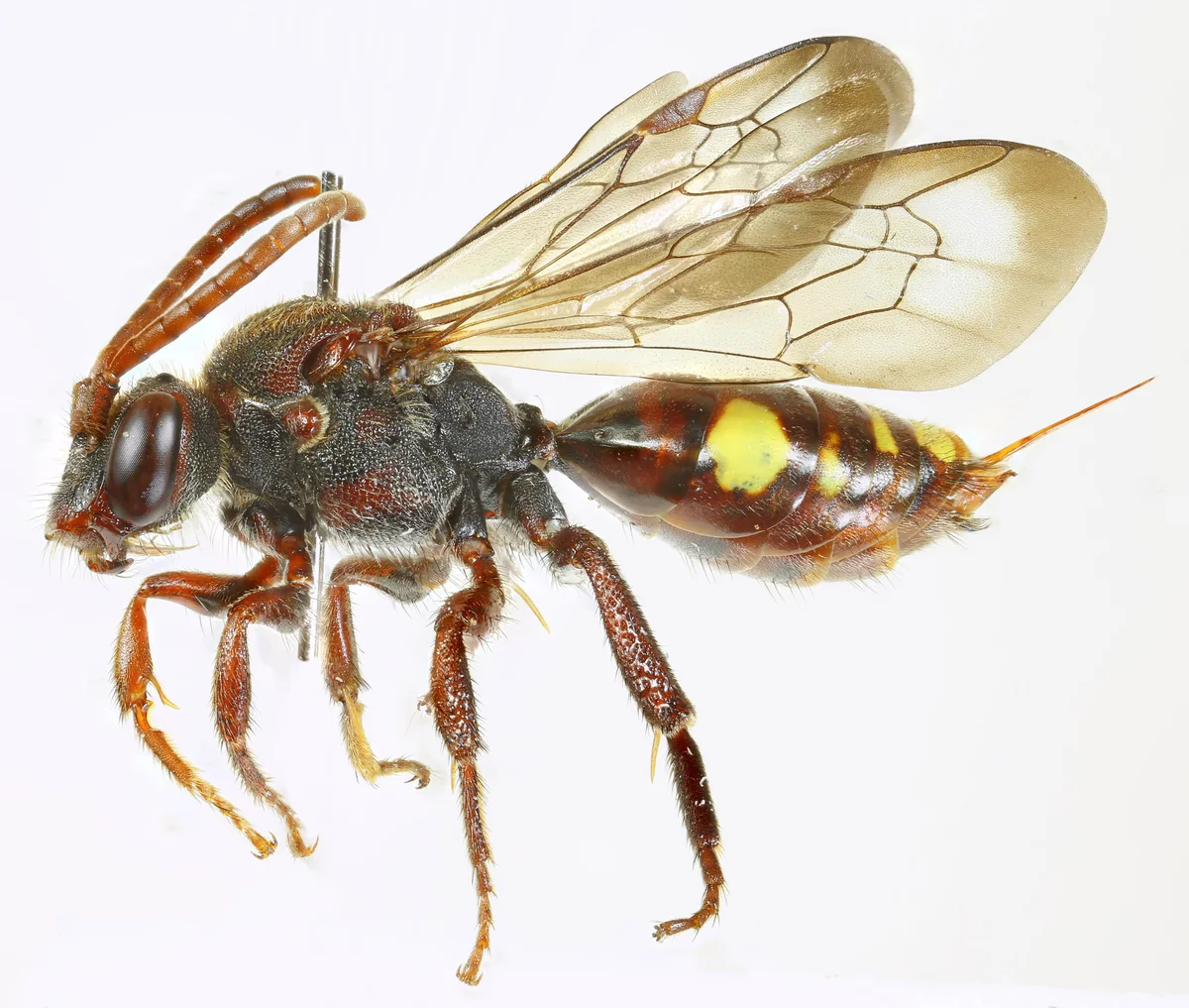
Cuckoo bees belong to several groups of bees. Some are slender and wasp-like; others look more like the familiar hairy bee. What they share lies in the nest, rather than in a uniform colour. They are a useful counterexample to the idea that all bees must do the same thing. Even within one group of animals, there can be very different ways of producing a new generation.
Inside a tiny store cupboard
In brood parasitism, the food prepared by a host bee becomes the food supply for another bee’s offspring. Depending on the species, the egg enters the cell during a particular stage of nest construction. It hatches into a larva whose development is adapted to these circumstances. The host’s egg or young larva is eliminated; the cuckoo bee larva then lives on the existing food supply.
Bee specialist Paul Westrich explains the distinction between brood parasitism and social parasitism in detail. An important point is that such a larva generally eats the pollen store: it is not a predator continually feeding on other bee larvae. The outcome is still fatal for the host offspring involved. Biologically, however, this is a different relationship from that of an animal hunting its prey.
Nomad bees really are bees
A first glance at nomad bees of the genus Nomada can be misleading: yellow or reddish markings and sparse hair suggest wasps. Many species use mining bees as hosts. Reliable identification to species often requires fine details, good photographs and experience. “Yellow and black, with no pollen” is not enough.
Another example is the large blood bee, Sphecodes albilabris. Its predominantly red abdomen is conspicuous. Westrich documents the spring plasterer bee, Colletes cunicularius, as a confirmed host. Here, dependence has a precise meaning: it concerns a suitable host species, rather than just any bee’s nest by the path. Understanding the little red bee therefore also means asking about the plasterer bee — and its habitat.
Visiting flowers without pollen baskets
Adult cuckoo bees need food for themselves. Females and males visit flowers mainly to drink nectar; pollen eating has also been observed. What they do not do is collect and carry a pollen store for their own larvae. The females therefore lack specialised collecting structures such as the pollen brushes of many other wild bees.
This explains why watching a flower visit alone tells us little about life in the nest. An animal can regularly drink at a plant without collecting its pollen for offspring. Conversely, males of nest-building bees do not collect pollen for brood cells either. The absence of a pollen load does not therefore make a bee a cuckoo bee. It is a clue calling for further observation, not a finished diagnosis.
When cuckoo bumblebees take over a nest
With cuckoo bumblebees, a social community comes into play. Their females seek out established nests of suitable bumblebee species. They can overpower the resident queen and use the host’s workers to rear their offspring. These social parasites produce new females and males, but no worker caste of their own.
This differs from the cuckoo bee in a single, provisioned brood cell. More than a food parcel is being used: care by living workers is part of the strategy. The Bumblebee Conservation Trust describes this change of nest ownership in the context of the bumblebee year. Here too, events depend on the species involved. Not every bumblebee nest is taken over, and not every large bumblebee without visible pollen is a cuckoo bumblebee.
Behind one bee there may be three lives
A cuckoo bee needs its host bee. The host needs a suitable nesting site and food plants. If it specialises in particular pollen sources, the dependence extends back to those plants. Losing one such connection can therefore mean losing more than the species that first catches our eye.
A species profile published by the Xerces Society illustrates this with the North American Epeoloides pilosula: its protection is linked to conserving its oil-collecting host bees and their loosestrife plants. This does not establish the situation of every German cuckoo bee, but it makes the structure of the problem clear. Conservation sometimes has to preserve an entire relationship. An attractively planted bed replaces that connection only if the crucial partners actually find suitable conditions there.

Patience at the nest entrance
To watch cuckoo bees, wait at a distance from a known wild bee nesting site. Look for animals inspecting entrances, sitting nearby or entering while another bee is away. If possible, photograph several views and note the date, place and bees nesting there. These details help with later expert assessment.
A single scene does not establish that successful egg laying has taken place. Nor must an unfamiliar animal at an entrance automatically be a brood parasite. Do not open cells to confirm a suspicion. Hidden development is part of the nest’s life. A good observation can end with an unanswered question. That is part of its appeal: discovering a second story behind the first without destroying it for a quick proof.
No villain in the wildlife garden
The term “parasite” describes a biological relationship, not a moral judgement. For the host bee, successful parasitism means a loss. For the cuckoo bee, the same event is the beginning of its life. Both perspectives belong in a complete picture. Choosing a landscape only for species that seem particularly useful or appealing would leave out a substantial part of its diversity.
Preserve nesting sites and suitable food plants rather than removing suspicious visitors. The appearance of a cuckoo bee can indicate the presence of hosts, but is not by itself a comprehensive quality mark for the whole garden. Above all, it shows that more is happening here than pollen collecting and flower pollination first suggest. Plants, nests and bees form a web of relationships. The unusual ways of life belong in it too.
Sources & further reading
- Paul Westrich: Parasitische Bienen – Brut- und Sozialparasitismus
- Paul Westrich: Steckbrief Sphecodes albilabris
- Paul Westrich: Blütenbesuch der Männchen und Kuckucksbienen
- Bumblebee Conservation Trust: Bumblebee nests – einschließlich Kuckuckshummeln
- Xerces Society / John S. Ascher: Cuckoo bees – Epeoloides pilosula