
A discovery becomes a shared opportunity
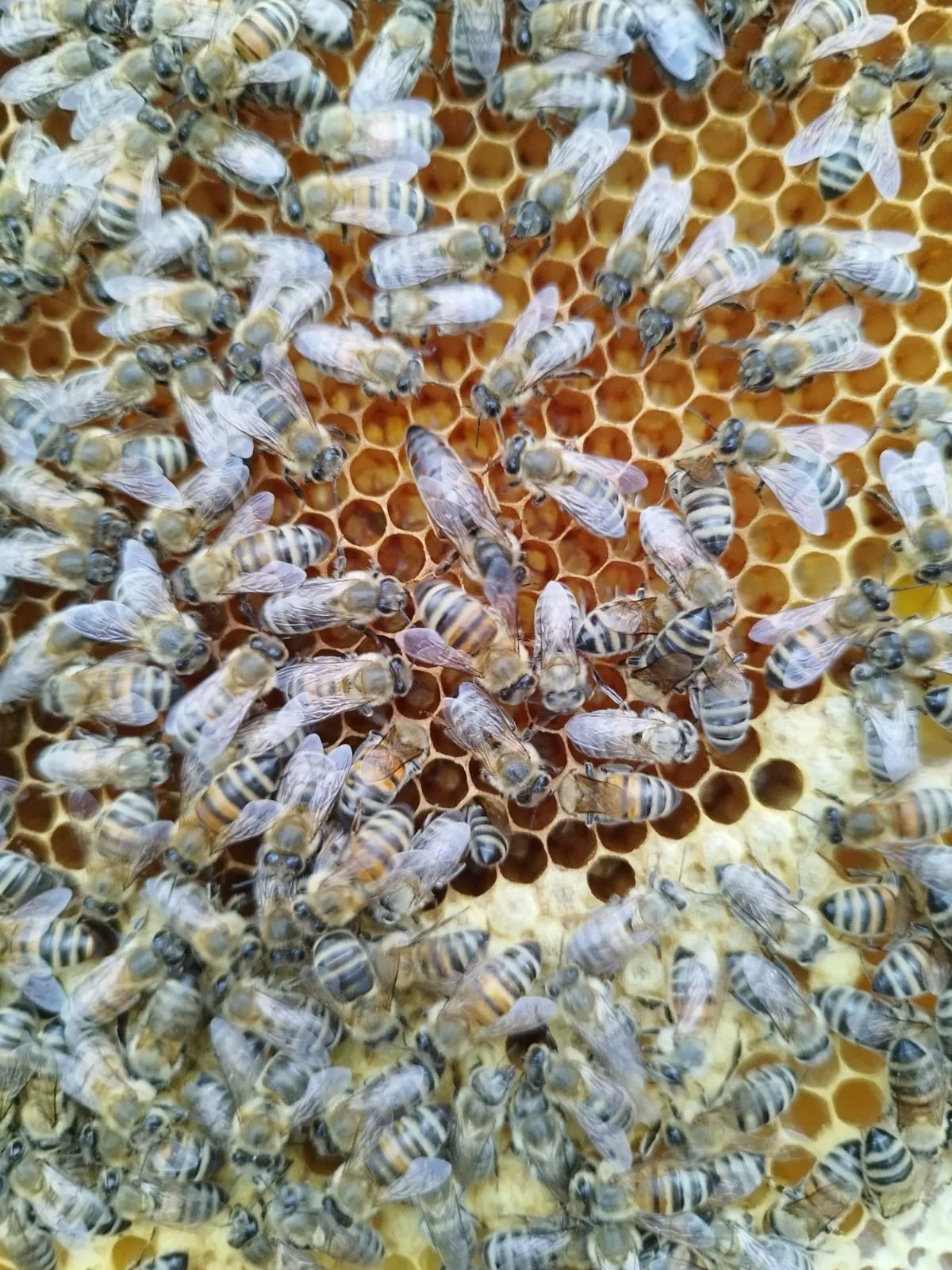
A rich food source becomes particularly valuable to the colony when more than a single forager can use it. Honey bees can recruit nestmates through dances. A successful returning bee provides information about her discovery: where is the source, how far away is it, and is the journey worthwhile? The colony thereby gains access to experiences individual bees have gathered outside.
The dance language discussed here is that of the western honey bee, Apis mellifera. It cannot be applied indiscriminately to all wild bees or bumblebees. Nor does a dancer issue binding work orders. The other workers respond to the opportunity, gather further clues and may fly out themselves. The dance can be understood as an invitation to investigate a discovery. For a short time, the returning bee’s body becomes a signpost.
The main message lies in the straight run
The familiar waggle dance consists of repeated waggle runs and return loops. The dancer first moves approximately straight ahead while swinging her abdomen from side to side. She then curves back. Alternating the side of the return gives the whole route a figure-of-eight shape. It is chiefly the straight waggle phase that carries location information, not the size of the two loops.
For a more distant destination, the waggle run generally lasts longer. This is information conveyed through time, not a line marked out in kilometres. A short film therefore reveals more than a still photograph: we need to recognise which part of the movement carries the message and measure its duration. One swing of the abdomen tells us no more about distance than a single photograph of a running bee. Repeated, structured movement is what matters.
Up the comb means towards the sun
On a vertical comb, gravity provides the reference. An upward waggle run indicates a food source in the direction of the sun. If the run slopes upwards to the left, the source lies at the corresponding angle to the left of the sun. A downward run indicates the opposite direction. The bee thereby translates a direction in the landscape into an angle on the comb.
Imagine the waggle run leaning about 45 degrees left of vertical. Outside, that means roughly 45 degrees to the left of the direction of the sun. It does not automatically mean north-west: the sun changes position during the day. The reference is moving. The receiver must translate the message into the conditions of her own flight. A short stretch of wax thus points to a much larger space.
The dance travels with scents
Inside a closed hive, no sunbeam lights the dancer like a spotlight. Following bees stay close to the returning bee; her movement and accompanying sound signals form part of the communication. There are also clues from the food source itself. A forager brings flower scent and may pass on some of the nectar she has collected. The location message therefore has a context of smell and taste too.
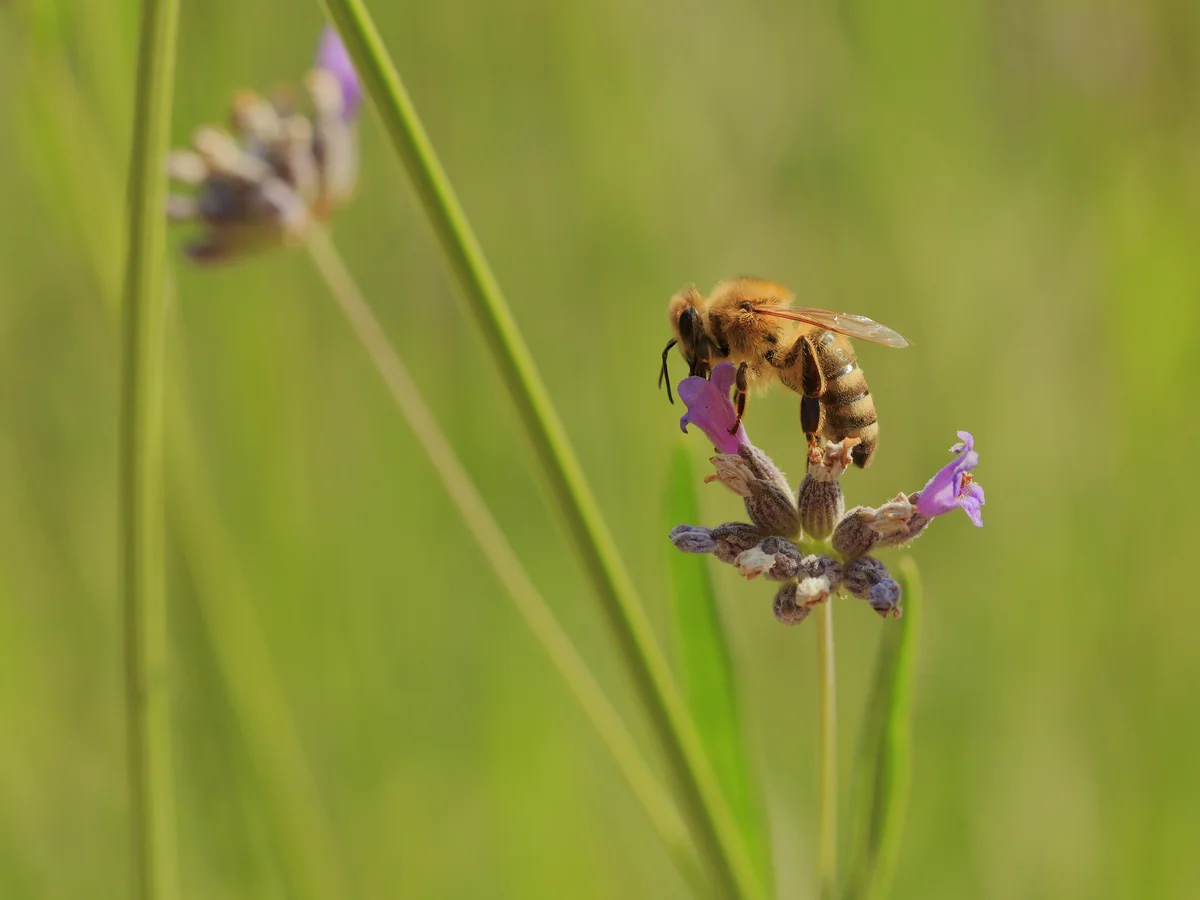
This helps explain an important distinction: knowing an approximate direction is different from finding the right flower. Many plants grow close together in a meadow. The journey therefore leads from a signal inside the hive into a landscape full of further sensory impressions. Dance information, scent and the bee’s own perception work together. Anyone familiar only with the drawn figure of eight has seen an essential part of the story, but not the entire search.
Research has followed the message outside
How can we test whether bees actually use the location information in the dance? Researchers can train foragers to a known feeding station and follow their return in an observation hive. The flights of recruited bees are particularly revealing. A study published in 2005 recorded such flight paths with harmonic radar and examined how receivers translate the dance message into a journey.
Nor are dances perfectly identical repetitions. Video analyses found variation in the direction and duration of individual waggle runs. The message has a spread. This usefully corrects our image of a flight map accurate to the millimetre. A bee’s body transmits under real conditions, among other animals and on a living work surface. Repetition and additional sensory clues become especially significant for understanding it. The achievement remains remarkable even though it does not replicate a navigation device.
More than two neatly separated dance types
Many accounts present the round dance and waggle dance as two separate words: one for nearby food, one for distant food. This is an accessible first overview. Closer investigation, however, blurs the boundary. A study by Gardner, Seeley and Calderone compared dances for feeding stations at different distances and found no clear switch between two entirely separate signals.
The researchers described round and waggle dances as the ends of a continuum. Waggle components and directional information could be detected even for very short journeys. A rigid distance threshold presented as a universal law of nature would therefore be misleading. The dance changes with distance, and some features become harder to recognise at close range. Biology is often easier to understand when we allow gradual transitions rather than forcing every observation into a sharply bounded category.
Good dancers need experience too
An experiment published in 2023 added another dimension to the classic picture. Young bees that had been unable to follow experienced dancers before their own first dance gave less orderly dances and made larger errors. Some deviations improved later through their own practice; inaccurate distance coding persisted under the conditions studied. Comparison with normally reared bees showed the importance of social experience.
This does not mean every movement is taught like a human dance class. The study examined precisely defined rearing conditions and found that social learning contributes to a biologically rooted ability. Information in a colony therefore arises through more than discovering new flowers. The quality of its transmission also depends on the community in which a worker can gain experience. A well-established signal is shaped in part by its surroundings.
A message’s value depends on the world outside
Directions help particularly when good food is hard to find or unevenly distributed. An experiment in different habitats examined colonies with usable and disrupted directional information. The advantage of communication varied with the distribution of flowers. High flowering-species diversity and larger flower-rich patches could increase its usefulness. A sophisticated ability therefore does not automatically bring the same benefit in every landscape.
If you have the chance to visit an observation hive under expert supervision, look for repeated waggle runs. Can you recognise a direction? Do other bees stay close? A brief observation does not replace precise measurement, but opens a different view: bees on the comb are connected to places we cannot currently see. In an unassuming movement, memory, experience and the collective search for food meet.

Sources & further reading
- Arizona State University, Ask A Biologist: Bee Waggle DanceDirection and distance in the waggle dance, and the role of scent and nectar cues.
- Okada et al. (2008): The dance of the honeybeeVideo analysis of variation in waggle-dance angle and duration, and the sequence of individual dance runs.
- Riley et al. (2005): The flight paths of honeybees recruited by the waggle danceInvestigation of recruited bees’ flight paths using harmonic radar.
- Gardner, Seeley & Calderone (2008): Do honeybees have two discrete dances to advertise food sources?Study of the transition between round and waggle dances: a continuum rather than two sharply separated dance forms.
- Dong et al. (2023): Social signal learning of the waggle dance in honey beesComparison of bees with and without prior dance-following experience: social learning and the influence of experience on dance accuracy.
- Donaldson-Matasci & Dornhaus (2012): How habitat affects the benefits of communicationExperiments on the usefulness of location information in different habitats, depending on flower distribution and species diversity.