
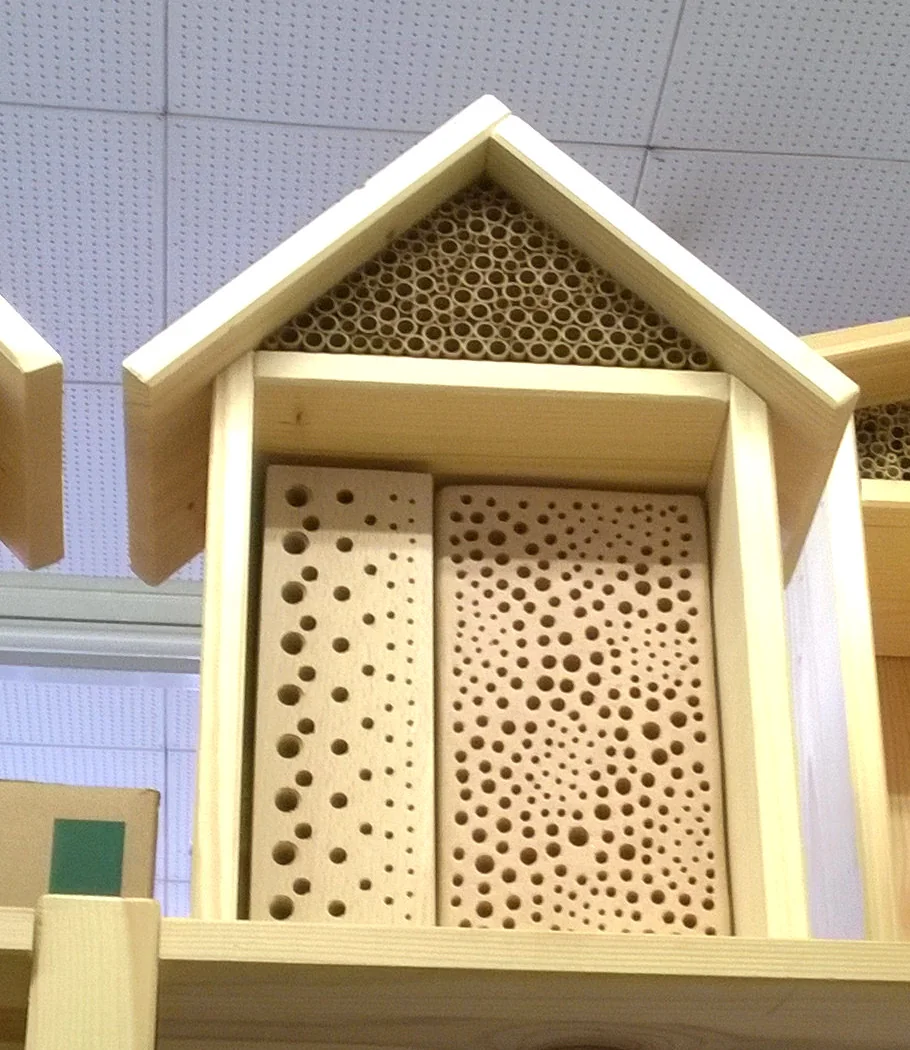

A good place to watch some wild bees
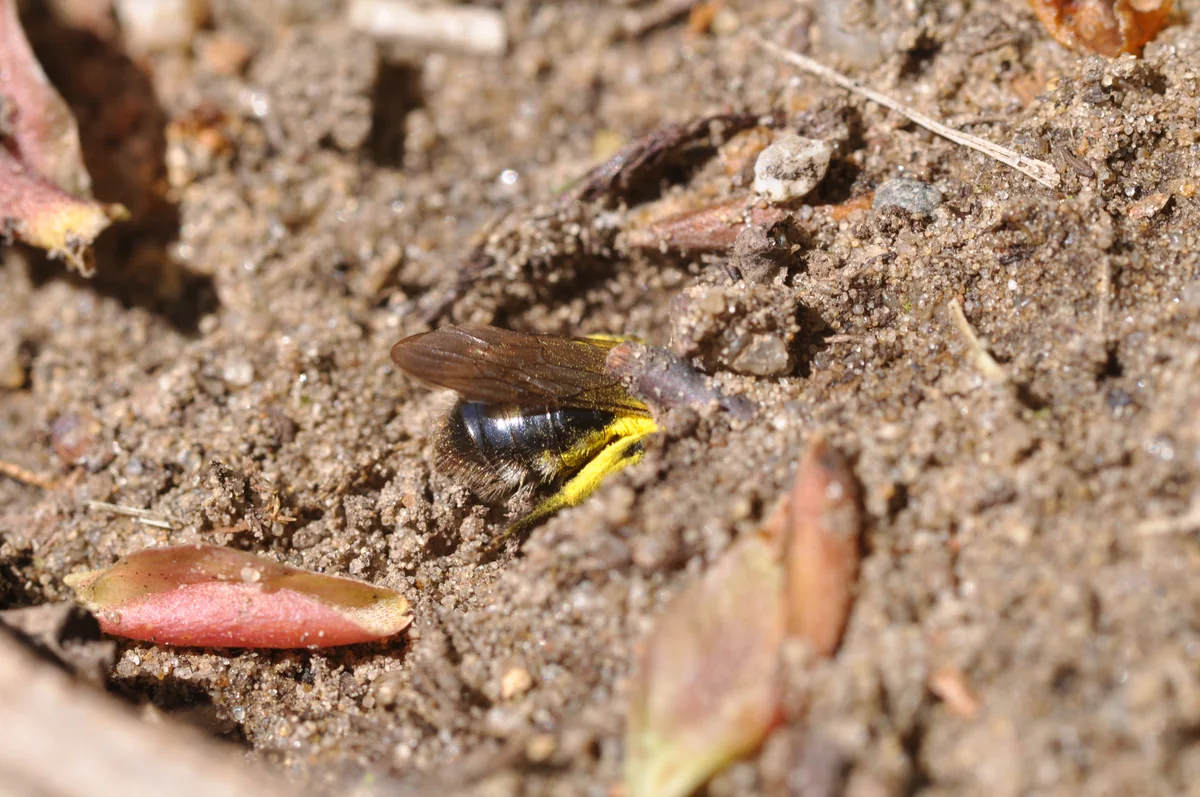
The familiar boxes with drilled holes and tubes cater for species that occupy existing cavities. Mason bees are frequent guests; depending on what is offered, scissor bees, Heriades bees or yellow-faced bees may also appear. Most native nest-building wild bee species, however, nest underground. A wall of tubes creates no suitable nesting site for them.
A nesting aid therefore does not replace a diverse habitat. Well built, it can provide fascinating insights and offer additional cavities to certain species. A large structure with many sealed holes does not prove that particularly threatened bee species have been saved. Familiar mason bees are among the frequent visitors. Supporting more species also means retaining natural nesting features and flowers nearby.

Materials that work as nesting tunnels
Well-dried, untreated hardwoods such as ash or hornbeam are proven choices. Holes are drilled from the former bark side across the grain. In decorative trunk slices, by contrast, holes are often drilled into end grain. Cracks develop more easily there. Damp, badly splintering or resinous wood is a poor starting point for clean nesting tunnels.
Reed or bamboo with smooth inner walls offers another option. Each tunnel needs an open entrance and a closed rear end, such as a natural node. Cut edges and inner surfaces must not fray. Cones, loose straw and large openings in hollow bricks do not provide suitable brood tunnels for these cavity-dwellers. Transparent plastic or glass tubes are unsuitable too, because moisture escapes poorly. Living brood should not be placed in such display homes for observation.
Small differences create different opportunities
A mixture of internal diameters is useful. For many nesting aids, a practical range is approximately two to nine millimetres; tunnels of three to six millimetres should be well represented. Offering only large tubes mainly favours larger mason bees. A small bee needs a different cavity from a large one.
Depth must suit diameter too. Smaller drilled wooden holes can be around four to six centimetres deep; large tunnels for horned mason bees should reach at least nine to ten centimetres. Bamboo tubes of around ten to twenty centimetres are common. Enough wood must remain between holes. Before installation, entrances and inner walls are carefully smoothed and drilling dust removed. A small, cleanly made block is more valuable than a large area of cracked, frayed or overly short tunnels.
Dry, secure and with a clear approach
A nesting aid needs firm support and must not swing in the wind. A bright, sheltered position with a clear flight approach is favourable. Facing south-east is often suitable; more important than following an exact compass rule is a place where rain does not drive into the tunnels. A roof should protect without leaving the entire front in permanent deep shade.
Brood remains in the nest after visible flight activity ends. The position must therefore work all year round. An occupied nesting aid is not brought into a warm house for winter. Suitable protective mesh can help where birds are actually preying on the nests. It needs sufficient clearance in front of the entrances and openings large enough for bees to fly through freely with their pollen loads.
Care begins with knowing what is occupied
Sealed nesting tunnels must not be routinely scratched open, drilled out or replaced. Larvae, pupae or already fully developed bees may lie behind them. Species emerge at different times; a tunnel can also be reoccupied soon after emergence. The calendar alone therefore does not reveal which tubes are really empty. An autumn clear-out can destroy the next generation.
Sensible care begins with regular observation and a dry, sound structure. New, clean tunnels can be added while occupied parts are retained. Replace only materials confirmed to have been vacated; seek expert advice if you cannot judge this confidently. Natural enemies are part of this community too. Not every unfamiliar-looking insect in front of the tubes is a pest we need to remove. A nesting aid is a piece of nature with all its interactions.
Real quality also lies in the surroundings
Alongside nesting tunnels, females need food and suitable building materials. Diverse flowers throughout their particular flight period are crucial. Species dependent on particular pollen sources cannot make up a shortage with just any other flower. Damp, accessible earth can provide mason bees with building material. Travelling between these resources forms part of their daily effort.
Natural features broaden the range: bare ground for ground-nesters, suitable dead wood and individual upright pithy stems for other species. Such stems are a separate provision, not simply filler to push between horizontal hollow tubes. A good wild bee garden accommodates different building methods. Within it, the nesting aid is a window onto a few readily visible life stories. Everything living beyond that window deserves the same space.
Sources & further reading
- Botanischer Garten der Universität Wien: Wildbienen-NisthilfenSuitable materials, drilling direction, smooth tunnels and cut edges, and typical unsuitable fillers.
- Paul Westrich: Nisthilfen für Besiedler vorhandener HohlräumeThe range of species that occupy nesting aids, limits to their conservation contribution, nesting tubes and protecting occupied structures.
- Nationale Naturlandschaften: Bau von Wildbienen-NisthilfenDiameters and depths, woodworking, pithy stems, surrounding food resources and natural enemies.
- Hans-Jürgen Martin: Handhabung und Pflege von NisthilfenPositioning, keeping nesting aids outdoors all year and reasons not to open potentially occupied tunnels.
- Stiftung Naturschutz Berlin: Nisthilfen für Wildbienen – Wie sinnvoll sind sie?Different natural nesting habits, correct woodworking and upright pithy stems.
- Carsten Pusch, NABU Schleswig-Holstein: Insektennisthilfen in Betrifft: NATUR 3/2023 (PDF)Especially page 13: do not open occupied tubes, monitor their condition and provide bird protection without obstructing access where needed.