
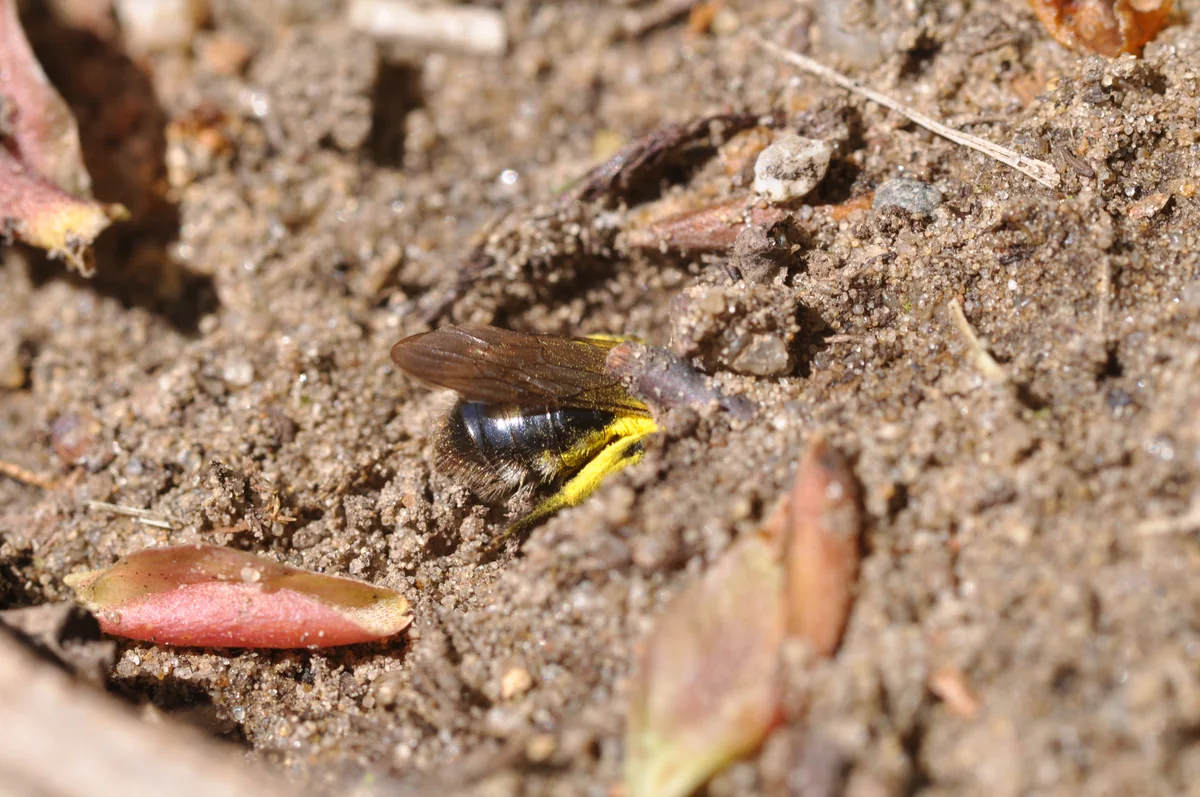

A home with an unassuming entrance
Most native nest-building wild bee species make their nests in the ground. They include many mining bees, furrow bees and small sweat bees. Some entrances stand out with little mounds of excavated earth; others remain hidden among grasses or in a bank. A drilled wooden block offers these species no substitute. Their construction begins with digging.
What we see at the surface is only the entrance. Depending on the species, tunnels of different depths lead below to individual brood cells or branching structures. A hole cannot, however, be confidently attributed to a wild bee from its appearance alone: other insects build underground too. Repeated observations of the animals flying in and out give a clearer picture. Waiting quietly beside the area is enough.
Sand, clay and the right kind of wall
The term ground-nester conceals very different requirements. Some species need loose sand, others a more cohesive soil, loess or clay. Position matters too: a level surface, a slope and a vertical exposed face offer different opportunities. Some bees prefer bare patches; others also nest among plants or at open woodland edges.
The soil must be workable while allowing the species’ particular construction. Grain size, cohesion and moisture affect its suitability. One good nesting site therefore cannot simply yield a universal recipe. A bee building in a clay wall needs something different from one inhabiting loose sand. Here, your garden is part of an established landscape with its own bee fauna, not an arbitrarily interchangeable substrate.
Providing for a small life
In solitary species, the female builds the nest and provides for her offspring herself. She prepares brood cells, brings in pollen and nectar, and lays an egg beside the food supply. These provisions support the future larva throughout its growth. Under the ground, flowers thus become stores for the next generation.
How cells are arranged and lined is species-specific. Developmental timing follows no single calendar either. Numerous species appear for only a few weeks; some have several generations a year. When flight activity at an entrance stops, the soil is therefore not necessarily empty. Much of a bee’s life takes place unseen. The absence of flying animals is not a reliable sign of an abandoned nesting site.
Many neighbours do not necessarily make a colony
In a suitable area, numerous solitary females may nest close together. These groups of nests are called aggregations. Each female provides for her own offspring. The busy coming and going looks communal from outside, but is not equivalent to a honey bee colony. The gathering exists because many animals use the same suitable place.
The grey-backed mining bee, Andrena vaga, is an illustrative example. It appears in spring, collects willow pollen and can form large nesting aggregations on sandy ground. Not all ground-dwelling wild bees are solitary, however: furrow bees and small sweat bees also include social species. Many holes therefore establish neither a shared queen nor, as a general rule, complete independence. Such claims require knowing the inhabitants.
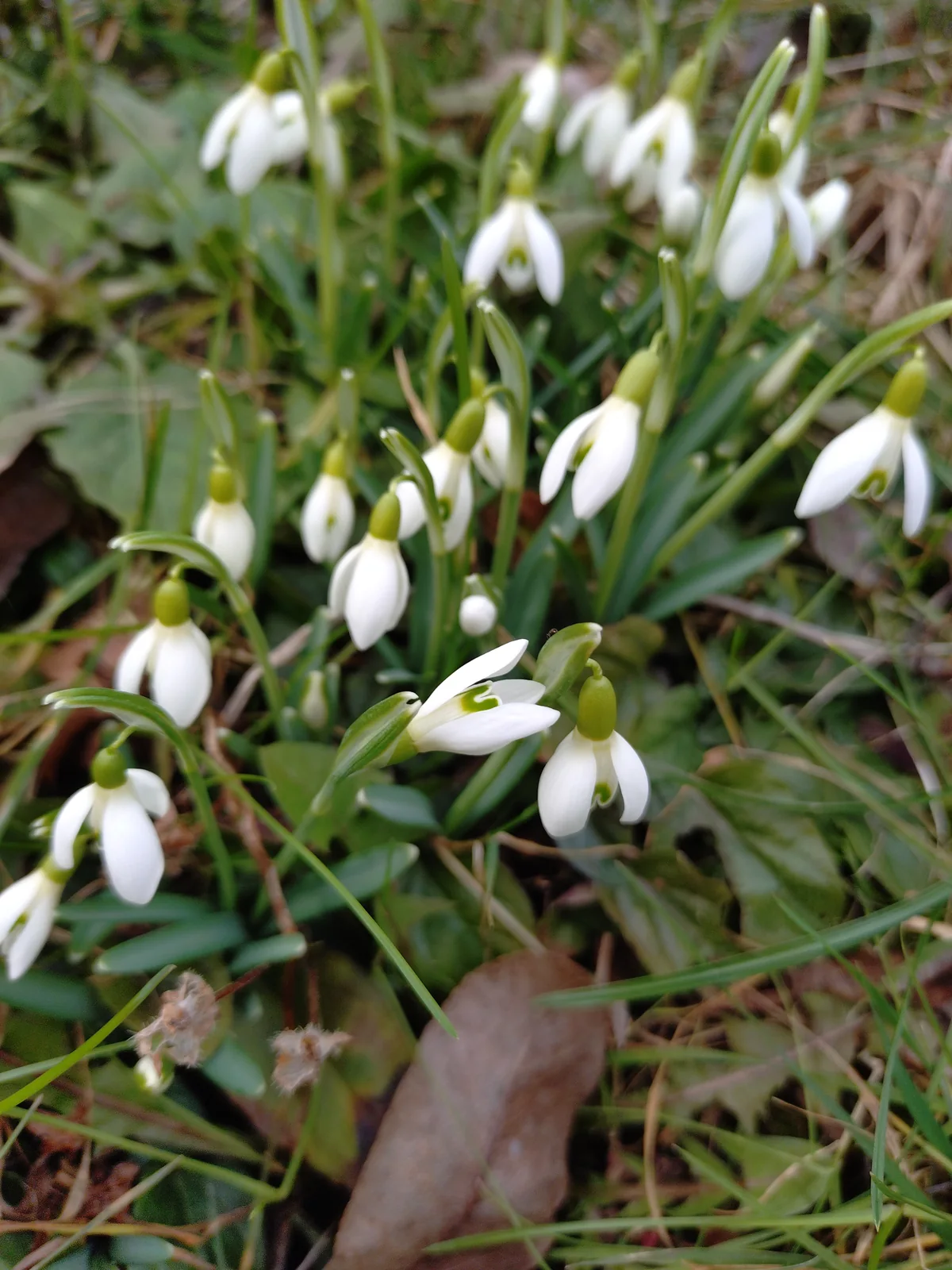
An existing nesting site is the best starting point
An already occupied site is particularly valuable. It shows that soil, position and surroundings work together. Paving it, digging it over or covering it with a thick layer of earth, mulch or gravel removes access and habitat. Deep ground work can also strike the hidden brood. Management should therefore begin with the actual nesting site.
It helps to mark such areas and agree their use with everyone who tends the garden. Vegetation can be carefully restrained without regularly loosening the soil deeply. Where nests already exist, strong roots should not be pulled out thoughtlessly. And because different species may share a place in different seasons, there is no universally safe month for a thorough redesign. Preserving is often more effective than recreating later.
A piece of ground belongs to the flowering landscape
Additional bare patches can be useful if they remain permanently and suit their surroundings. An indiscriminately created sand bed does not, however, guarantee occupation. The species present must accept the substrate, reach the site and find suitable flowers. In a sandy area, simply keeping an appropriate spot open may help; elsewhere, the local soil structure is the better starting point.
Food at the right time matters just as much. A late-summer flower display does little to provision the brood of a spring bee specialised on willow pollen. Nesting sites and flower resources belong together. Keeping both in mind reveals a different measure of a beautiful garden: a small gap in the greenery can be an entire habitat. And an inconspicuous hole tells of a future being prepared just beneath the surface.
Sources & further reading
- Universität Hohenheim, Landesanstalt für Bienenkunde: Die Lebensweisen der Bienen DeutschlandsNest building, different social systems, nesting aggregations and seasonal developmental cycles.
- Paul Westrich: NistplatzwahlSpecies-specific requirements for soil, vegetation, slopes and vertical faces.
- Paul Westrich: Förderung von im Boden nistenden ArtenLimits of generic sand beds, differences between substrates and preserving existing nesting aggregations.
- Bayerisches Landesamt für Umwelt und Universität Würzburg: Wildbienen in Dörfern – Nahrung, Nistplätze, Lebensräume (PDF)Especially pages 25 and 33: hidden ground nests, threats from ground work and long-term management.
- BUND Köln: Die Weiden-Sandbiene kommt mit dem FrühlingAndrena vaga as an example: flight period, dependence on willow pollen and solitary nesting in aggregations.