
.jpg)
The first flight begins behind a wall
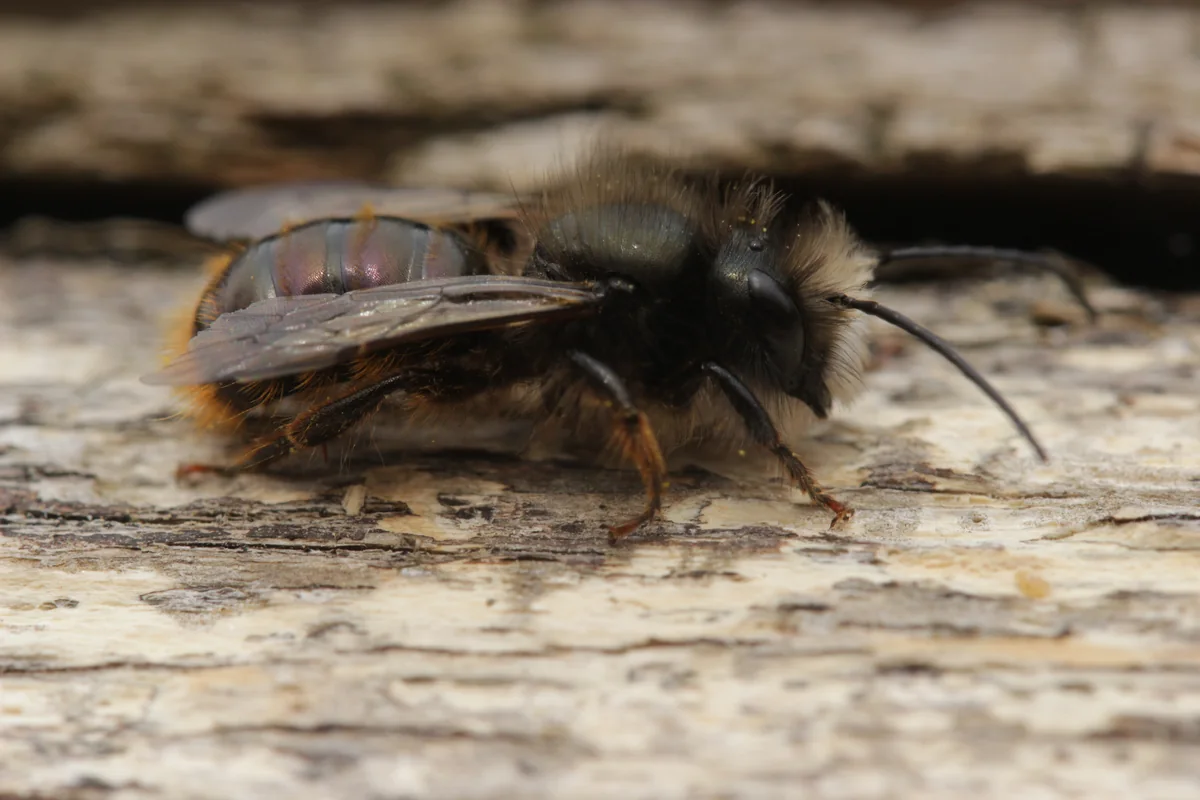
The new generation spends winter as fully developed bees inside their cocoons. In spring, they work their way out of this covering and through the nest seal to the outside. Males usually appear a few days before females. In mild places, Osmia cornuta may emerge very early in the year; the visible season often begins in March. Weather and location shift the date.
The males can be recognised partly by their pale facial hair. Females have the little horns on the head that give this species its common name. Another familiar species, the red mason bee, Osmia bicornis, generally appears later. Mason bees do not all follow one spring calendar. Even within a species, conditions in a warm urban garden do not necessarily match those at a cooler site.
An existing cavity becomes a nursery
After mating, the female searches for a suitable nesting site. She uses existing cavities, for example in walls, plant stems or well-built nesting aids. The name mason bee does not mean that she lives exclusively in masonry. What matters is a usable space for the brood cells. Suitable openings are approached and inspected until one becomes a nest.
The horned mason bee is solitary. Each female builds and provisions her own cells; there is no workforce to take over food-gathering flights. Nevertheless, many females can nest right beside one another. What looks like a shared enterprise at a busy nesting wall consists of numerous independent life stories. For each female, finding a space, building, gathering food and laying eggs must all fit into her short flying season.
One cell, one egg and food for the entire larval stage
In the elongated nesting tunnel, cells are usually built one behind another. The female collects pollen and nectar as food for her offspring. She carries pollen in a dense brush of hairs on the underside of her abdomen. Damp earth or clay provides material for the partitions. More flights link the flowers, the source of building material and the nest.
When a cell’s food supply is complete, the female lays an egg and seals the chamber. Only then does she begin the next cell. She does not return daily to keep feeding the larva as a honey bee nurse does. Everything it needs to grow must already be in place. An outer seal finally protects the structure. Behind it lies a row of tiny store cupboards, intended to produce the following spring’s generation.
While summer arrives outside, transformation begins
A legless larva hatches from the egg. It eats the provisions and grows without leaving its brood cell. Later, it spins a cocoon. Further developmental stages follow inside, leading to the pupa and finally the adult bee. The cocoon is the protective covering; pupa describes a developmental stage of the animal. They are not the same thing.
In Osmia cornuta, transformation into the adult is completed in the year the egg was laid. A quiet tube in summer can therefore hide different stages. By then, the mother seen in spring is usually no longer alive. Her offspring develop with what she left behind. The generations share no daily family life, but are connected by carefully prepared provisions.
Winter belongs to the adult bee inside the cocoon
By autumn, a fully developed insect is already waiting in the nest for the following spring. It does not fly out yet, although it has legs, antennae and wings. Osmia cornuta has only one generation a year. The bees spend the long hidden part of their lives where they developed, until conditions are right for leaving the nest.
This explains why a sealed nesting tunnel is not an empty space in winter. An occupied nesting aid still belongs outdoors in a suitable, weather-protected place. A warm living room can disrupt the timing and cause bees to emerge too early. Nor does winter care mean scratching open the seals or cleaning them indiscriminately. Anyone hoping to watch bees in April must take their invisible months into account.
A new year needs more than an empty tube
When males appear at the nest entrance again the following spring, the annual cycle is complete. The visible weeks of flight belong to a life that began long before, as an egg. Food plants must now be within reach, along with suitable cavities and damp building material. Osmia cornuta uses pollen from different plant families; early-flowering shrubs, trees and herbaceous plants can provide for its short season.
Watching requires only distance and patience. A sealed entrance can be photographed and compared over the months without opening it. Repeated short visits show particularly well how different a nesting wall looks in March, June and January. This common mason bee offers a wonderful introduction to wild bees. Their full diversity also includes species whose nests are hidden underground or in very different structures.
Sources & further reading
- Paul Westrich: Gehörnte Mauerbiene – Osmia cornutaSpecies-specific features, nesting habits, pollen sources, flight period and overwintering as an adult bee.
- Paul Westrich: Solitäre BienenThe life cycle of Osmia cornuta, provisioning individual brood cells and the separation of generations.
- Paul Westrich: Entwicklung der BieneEgg, larva, cocoon, pupa and adult; the illustrated developmental sequence on the source page shows Osmia bicornis.
- Hans-Jürgen Martin: Gehörnte Mauerbiene – Osmia cornutaDistinction from the later-emerging red mason bee, as well as identifying features and nest construction.
- Hans-Jürgen Martin: Handhabung und Pflege von NisthilfenKeeping nesting aids outdoors all year, the risks of warm overwintering and protecting occupied nesting tunnels.