
What the pictures show
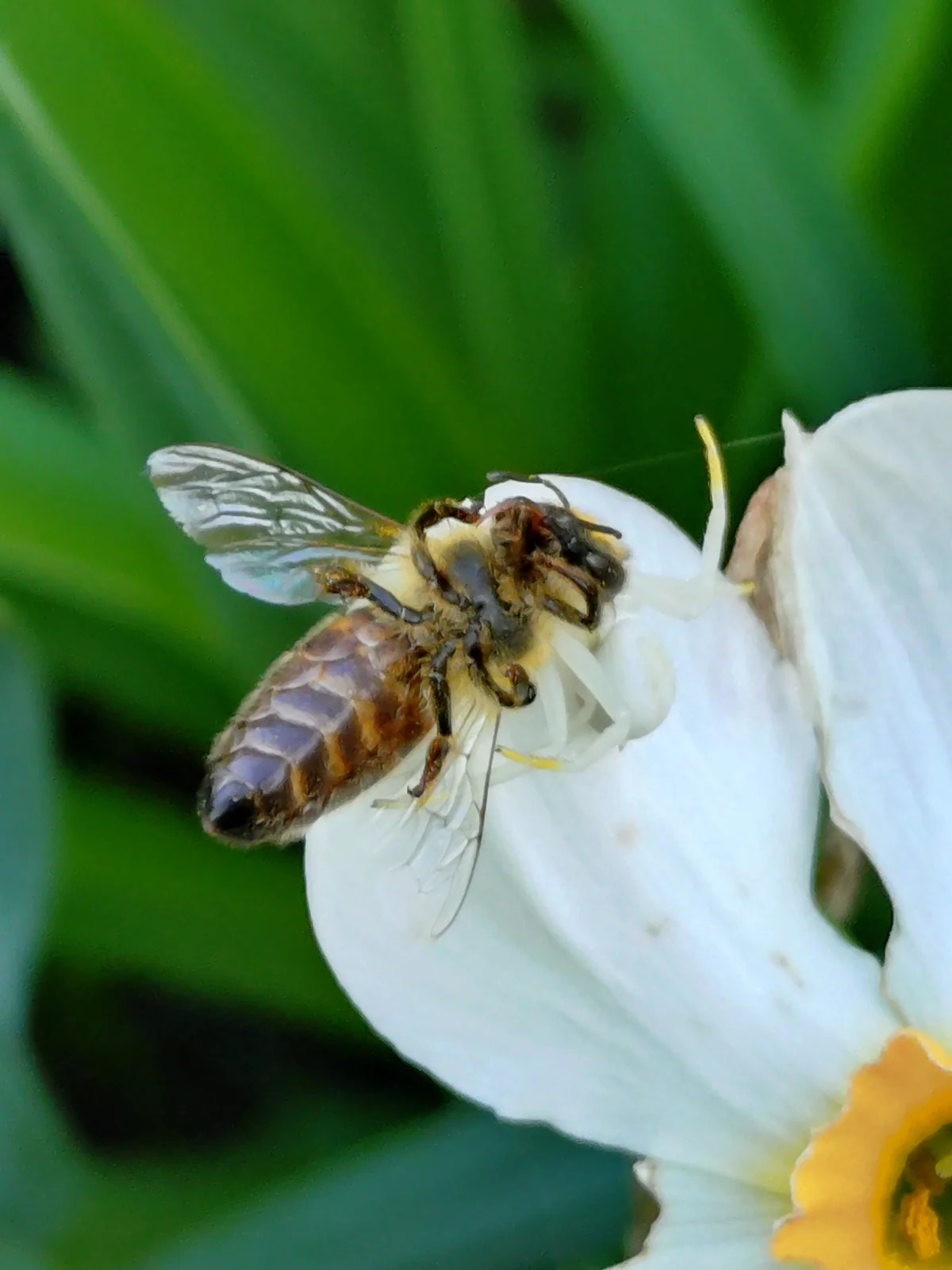
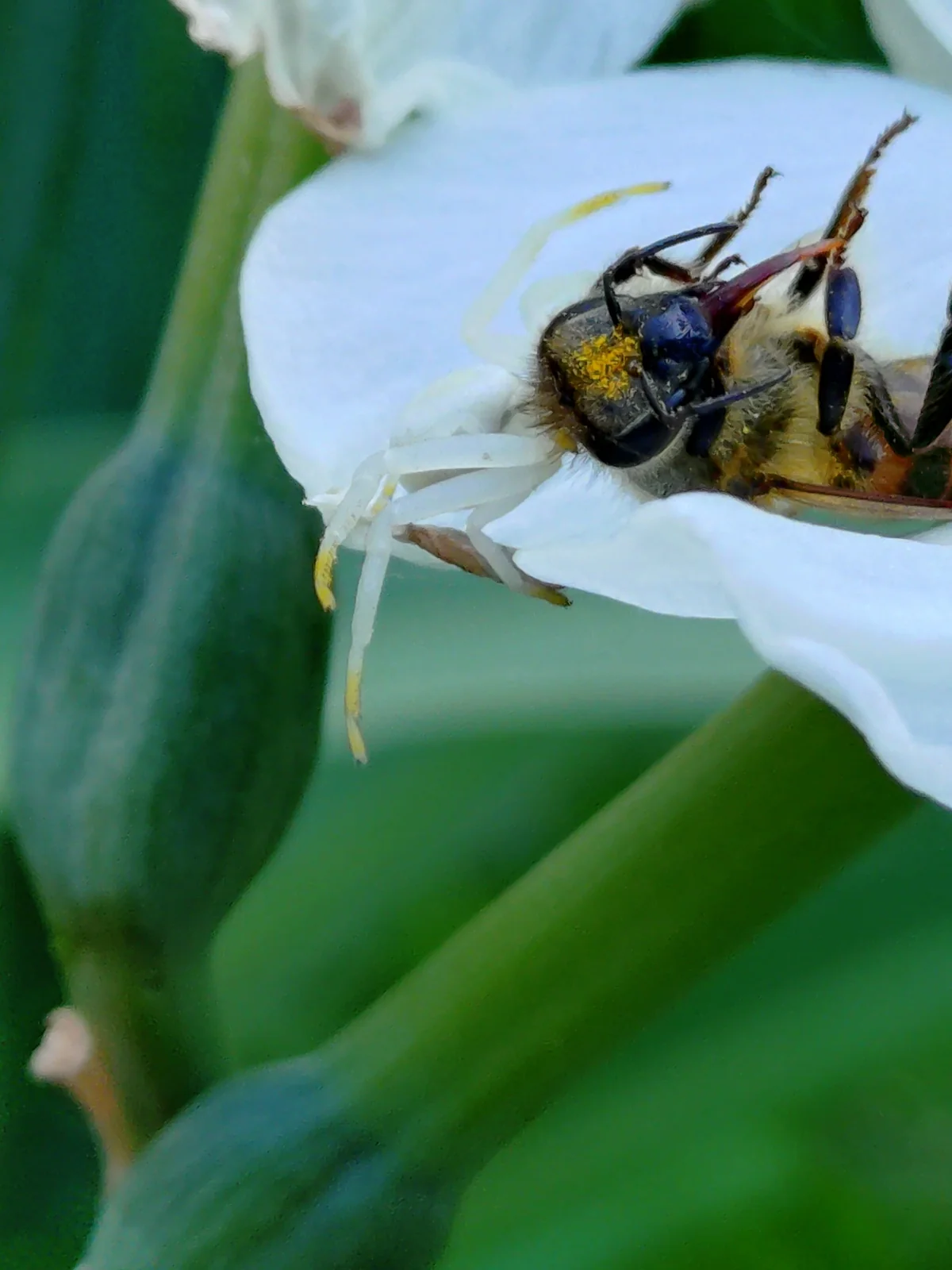
The pale spider is holding a honey bee. Its strong, sideways-facing front legs are characteristic of crab spiders, the family Thomisidae. The precise species cannot be identified with confidence from these photographs.
What initially looks like an ordinary flower visit is an encounter between hunter and prey. The photographs show the hold, not the attack that preceded it. To our eyes, the spider’s almost white legs disappear among the petals.
Lying in wait among the flower visitors
Flower-dwelling crab spiders hunt without a prey-catching web. They wait among petals or on a flower head until an insect comes close enough. Then the front legs seize it. A venomous bite helps subdue the prey — including animals larger than the spider.
Alongside bees, flies, beetles and butterflies can be on the menu. The spider predigests soft tissues and takes in the liquefied food. A largely intact outer shell may remain. The flower gives the hunter a place where potential prey keeps passing by.
Camouflage takes time
In some species, adult females can change their body colour between white and yellow. One example native to Germany is the flower crab spider, Misumena vatia. The change takes days. Not every crab spider has this ability, and a pale colour does not establish a species name.
Whether a matching colour also brings more prey is a separate question. In a field experiment, Misumena vatia matching their flowers caught no more than differently coloured spiders. Different groups of flower visitors also responded differently to the spiders. What seems well hidden to us need not look the same to a bee.
Bees learn about danger too
In experiments with artificial flowers, bumblebees learnt to avoid simulated spider attacks. After experiencing hard-to-detect predators, they inspected flowers for longer and more often rejected even safe options. Caution cost time and sometimes a meal.
Movement also mattered in studies of an Australian crab spider species: when the spider moved as a honey bee approached, the bee was more likely to abandon the visit. Keeping still is therefore as much a part of ambush hunting as body colour. A photograph alone cannot reveal the prey’s response.
One flower, several lives
Danger can change visiting behaviour beyond the individual hunting site. In bumblebee experiments, simulated attacks led bees to avoid safe artificial flowers with a similar appearance too. The lives of predators, pollinators and plants are connected in this way.
If you discover a crab spider, watch from a little distance: where is it sitting? How does it hold its front legs? Does it stay still as other insects approach? A photograph from above and one from the side can help with identification later. There is no need to move animals or offer bees to the spider.
The same flower that feeds a forager also feeds her hunter. Bertram’s pictures make this small, easily overlooked part of the food web visible.
Sources & further reading
- Australian Museum: Flower SpidersFeatures of the family Thomisidae, ambush hunting, prey capture and feeding; examples from Australia.
- Nationalpark Donau-Auen: Veränderliche KrabbenspinneBiology of Misumena vatia, ambush hunting and the slow colour change of adult females.
- Brechbühl, Casas & Bacher (2010): Ineffective crypsis in a crab spider: a prey community perspectiveField experiment with Misumena vatia: colour matching, visitor groups and capture success.
- Ings & Chittka (2008): Speed-Accuracy Tradeoffs and False Alarms in Bee Responses to Cryptic Predators (PDF)Experiments with artificial flowers: longer inspection and more frequent rejection of even safe options after simulated attacks.
- Llandres & Rodríguez-Gironés (2011): Spider Movement, UV Reflectance and Size, but Not Spider Crypsis, Affect the Response of Honeybees to Australian Crab SpidersField investigations with Thomisus spectabilis and honey bees; the importance of movement and other visible traits.