
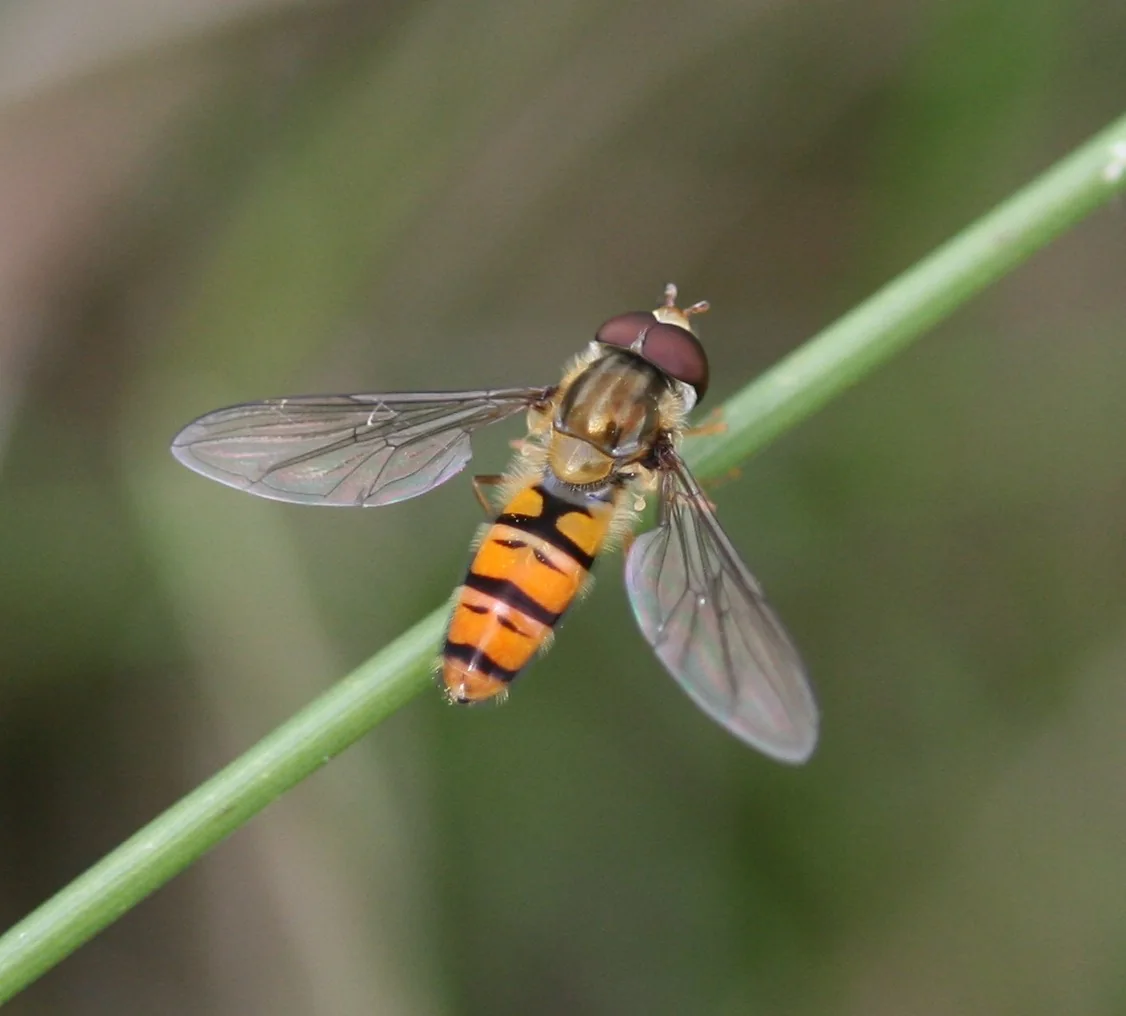

Yellow and black are no proof of identity
A honey bee does not have to be striped in bright yellow. Many look more brown or grey. Among wild bees, there are black species, reddish-haired ones and others with a metallic sheen. Some are scarcely larger than a grain of rice; others have a conspicuously sturdy body. The familiar picture-book bee does little justice to this diversity.
Conversely, many hoverflies bear stripes or spots that resemble those of wasps. Others look like small bumblebees in their thick fur. Hoverflies have no venomous sting and do not sting people. This resemblance is a form of mimicry: a harmless imitator can benefit from the warning appearance of a well-defended model. The disguise is so convincing that it regularly fools us too. Colour therefore offers a clue, but not yet a reliable identification.
Two wings or four?
Hoverflies belong to the true flies, the Diptera. They have one pair of fully developed flight wings. Bees and wasps, by contrast, belong to the Hymenoptera and carry two pairs: larger wings at the front and smaller ones behind. This distinction is particularly useful for beginners because it holds across different colours and body shapes.
Counting the wings on a living animal is tricky, however. A bee’s hind wings can lie behind its forewings and be almost impossible to see. In a fleeting photograph, four wings can easily look like two. A sharp picture from above or at an angle from the side helps. There is no need to catch the animal or make it spread its wings.
Antennae and eyes add to the story
Many hoverflies have conspicuous compound eyes that occupy a substantial part of the head. Their antennae are often short and look stubby compared with those of a bee. Bees and the yellow-and-black social wasps in our gardens usually have longer, clearly segmented antennae. Together with the wings, these features provide a useful first impression.
Here too, the combination matters. Some hoverflies have noticeably longer antennae, while male honey bees have particularly large eyes. A single feature should therefore never displace the other observations. If you first notice “short antennae and very large eyes”, you can next look specifically for the pair of wings. Identification then becomes a sequence of small observations that can be checked.
Where the pollen travels
Many female bees collect pollen as food for their offspring. Honey bees and many bumblebees carry it in conspicuous parcels on their hind legs. Other wild bees transport it loosely in brushes of hairs on their legs or on the underside of the abdomen. A pollen-carrying structure full of pollen is a strong indication of a bee.
Yet the absence of pollen parcels does not prove otherwise. An animal may have only just set out, or may be collecting nectar. Males do not provision their own brood with pollen, and cuckoo bees leave food collection to their hosts. Loose pollen can also cling to a wasp or hoverfly. Being covered in pollen is different from deliberately transporting it to a nest.
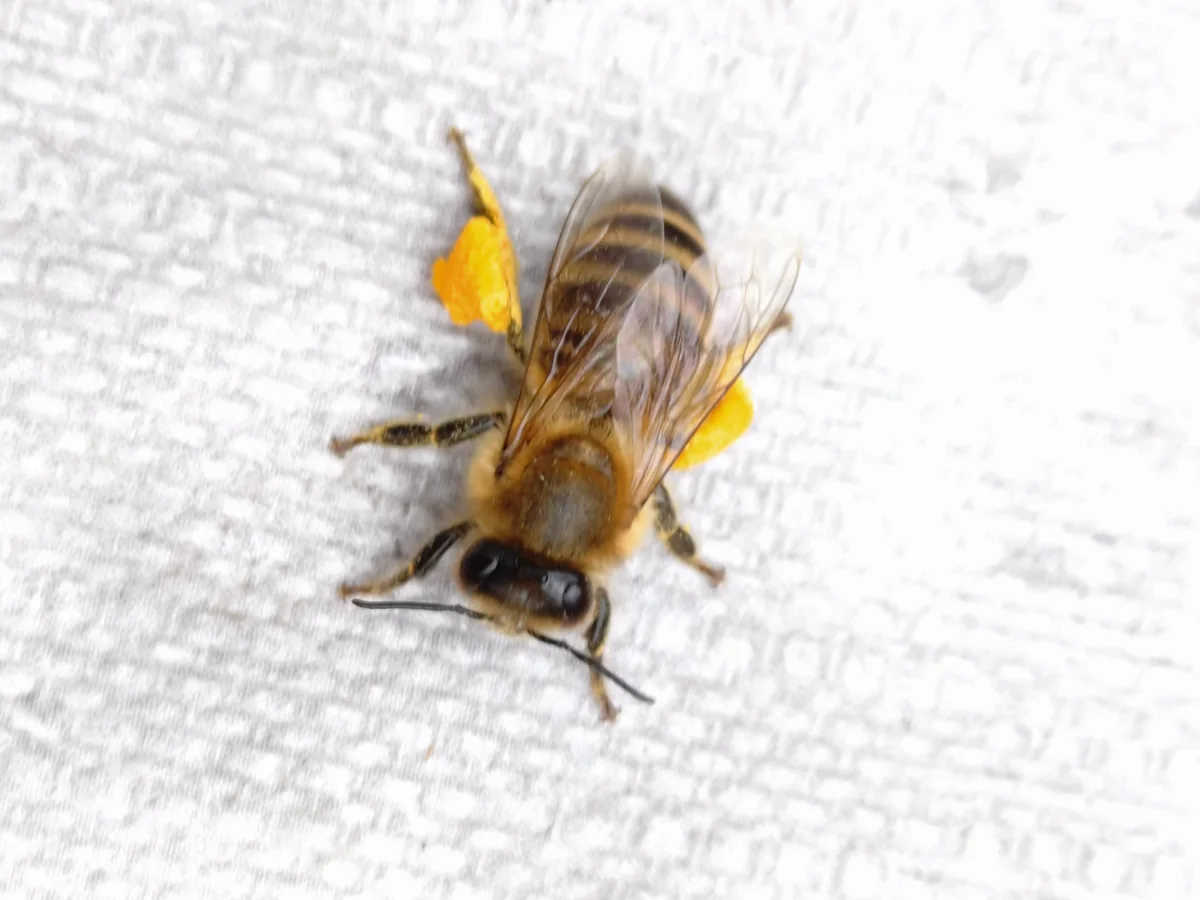
Three visitors, different roles
Many wasps look smoother and slimmer than bees. Even so, the familiar narrow waist is not reliable proof on its own: bees also have a constriction, often less obvious beneath their hair. Many wasps collect animal prey for their larvae. The adults also visit flowers and use their sugary food. In doing so, wasps too can transfer pollen.
Adult hoverflies likewise find food on flowers and contribute to pollination. Depending on the species, their larvae live very differently: many eat aphids, while others use organic material or plant tissue. A wasp is therefore more than an ill-tempered bee, and a hoverfly more than a meaningless copy. Behind the similar outlines lie different life stories.
A good photograph can leave a question open
For identification, a short series of pictures is worthwhile: the whole body from above, a side view and, if possible, the head. The flower, location, date and an approximate size add to the record. Pictures showing the abdomen and wings are more useful than a very tight crop that cuts off essential features. You can enlarge an image later.
The conspicuous hovering flight is an additional clue for many hoverflies, but not proof on its own; some bees can also hover. Reliable identification to species can ultimately depend on tiny details that a garden photograph cannot show. In that case, “hoverfly” or “wild bee, species unidentified” is an honest and valuable observation. The photograph remains accurately labelled, and the next encounter may take the question further.
Sources & further reading
- UK Pollinator Monitoring Scheme: FIT Count insect identification guide (PDF)Comparison of wing pairs, eyes and antennae; limitations of identifying living flower visitors, including hoverflies with longer antennae.
- University of Minnesota Extension: Basic Bee ID (PDF)Basic features of bees, wasps and flies; pollen brushes and body characteristics.
- Utah State University Extension: Beginner’s Guide to Common Native BeesBee diversity, pollen-carrying structures in females, and differences from flies and wasps.
- Royal Horticultural Society: HoverfliesMimicry, absence of a venomous sting, flower visits and the different ways of life of hoverfly larvae.
- Natural History Museum: Seven insect heroes of pollinationPollen transport by wild bees, flower visits and the contribution of wasps to pollination.
- Natural History Museum: Meet the bee-flyHovering is not exclusive to flies; the hairy-footed flower bee can hover too.